
Toyota Central R&D Labs, Inc. has successfully improved lithium-ion batteries’ performance by introducing non-metallic elements, focusing on lithium manganese oxide (LMO) as a cathode material. The introduction of nonmetallic elements such as boron and phosphorus has demonstrated the effects of long-cycling and high-capacity, respectively. These results were published in John Wiley & Sons' journal Advanced Energy Materials (online) on October 17, 2023. For the full text of the press release (in Japanese), please click the link below.
-
 press release
(783KB)
press release
(783KB)
【Summary】
We have demonstrated in test batteries that longer life and higher capacity can be achieved by controlling the crystal structure of LMO (disordered rock-salt type), which has fewer resource constraints, without using Co and Ni, which are resources of concern for sustainability, as positive electrode materials for lithium-ion secondary batteries.
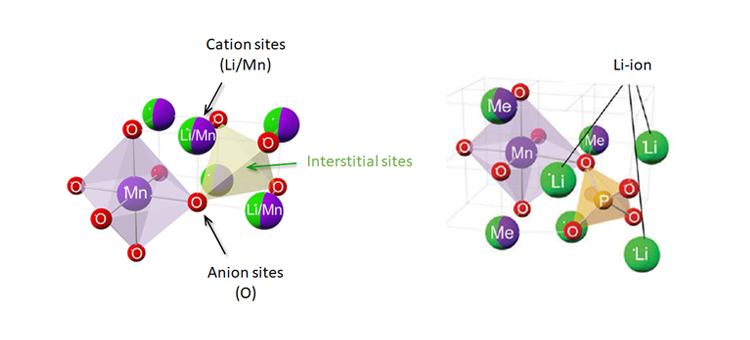
- Long-life: The doping of nonmetallic elements B into interstitial sites stabilizes the crystal structure and maintains capacity even after repeated use.
- High-capacity: The doping of nonmetallic elements P into interstitial sites increases the amount of lithium-ions absorbed and released, resulting in a high energy density.
【Article Information】
Title:Activation and Stabilization of Mn-based Positive Electrode Materials by Doping Nonmetallic Elements
Authors:Mahara, Y., Oka, H., Nonaka, T., Kosaka, S.,- Takahashi, NT., Kondo, Y. Makimura, Y.
Journal Name:Advanced Energy Materials
Published:October 17, 2023
https://doi.org/10.1002/aenm.202301843