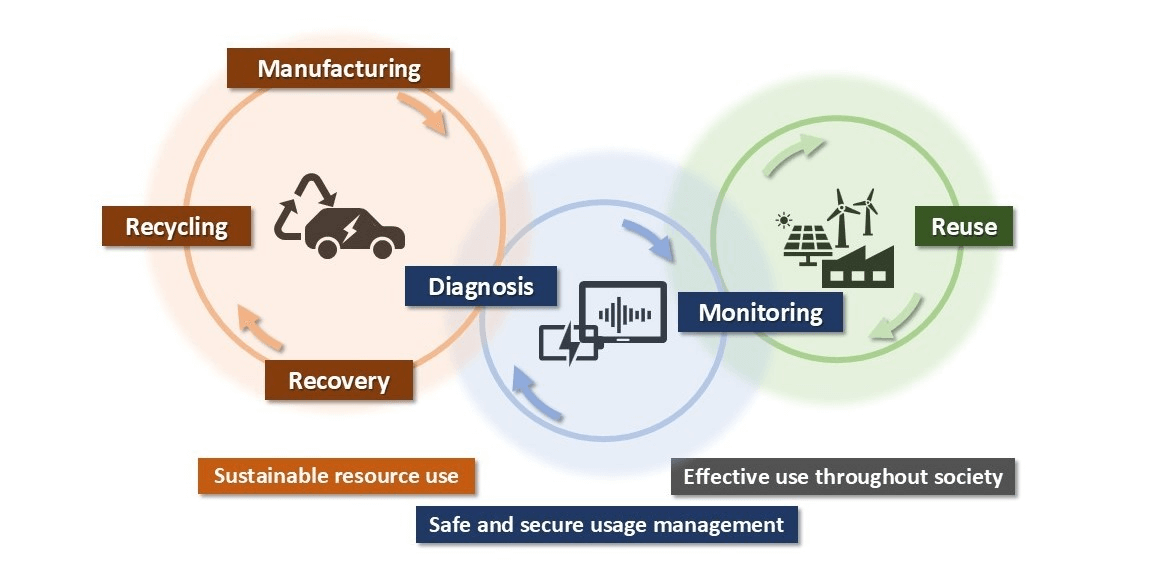


Toyota Central R&D Labs., Inc. has developed a new battery deactivation technology, “iSleep™,” that reduces risks during the recycling of lithium-ion batteries (LiBs). This technology works by adding a redox shuttle [1] agent (hereinafter referred to as an RS agent) to discarded LiBs, enabling the residual voltage within the batteries to be discharged to near 0 V. As a result, risks such as heat generation during LiB disassembly and crushing are significantly reduced.
The results of this research were published online on February 11, 2024, in Scientific Reports, a Springer Nature journal. For the full text, please refer to the link above.
Key Research Points
- Recycling processes involving the disassembly and crushing of LiBs require pretreatment to deactivate the batteries, including discharging residual voltage and removing deposited lithium (Li) metal.
- An RS agent was identified that electrochemically induces an internal short circuit between the cathode and anode, enabling residual voltage to be discharged to near 0 V while simultaneously dissolving deposited Li metal.
- By reducing risks during LiB recycling, this technology contributes to more efficient resource utilization and a lower environmental impact during battery manufacturing.
Note
[1] Redox shuttle:
A process in which redox-active species —phenothiazine in this study— repeatedly undergo oxidation and reduction reactions between the cathode and anode within the battery.