

-
 Printable version
(420KB)
Printable version
(420KB)
Toyota Central R&D Labs., Inc. has developed the Koro-rin method, a simple technique for collecting environmental DNA (eDNA) from terrestrial environments (Figure 1). This method uses a roller fitted with disposable nonwoven fabric to collect eDNA from ground surfaces. Analysis of the collected eDNA provides information about the species present in the surrounding area. A 14-month field study demonstrated that the method can track changes in terrestrial vertebrate communities over time. Because it requires neither specialized equipment nor a power supply, the Koro-rin method can be used in a wide range of environments, offering a practical means of improving the efficiency of terrestrial biodiversity monitoring.
The research was published online in the international scientific journal Environmental DNA on February 1, 2026.
Research Highlights
- Developed the Koro-rin method, a terrestrial eDNA sampling technique that collects eDNA simply by rolling a sampler across the ground surface.
- Detected 53 bird and mammal taxa during a 14-month forest survey, showing strong agreement with camera trap observations.
- Because the arrival times of migratory birds corresponded with the detection results, we demonstrated that seasonal changes in biota can be detected through environmental DNA on the ground's surface.

- 拡大
- Figure 1. Ground-surface sampling using the Koro-rin method.
Background
Biodiversity loss has become a global challenge, driving stronger efforts to achieve a nature-positive society by halting and reversing this loss. Effective conservation requires the long-term monitoring of species distribution and ecosystem changes over time.
While conventional biodiversity surveys, including visual observations and camera trapping, are well established, they often require substantial time and labor, limiting the large-scale and frequency of monitoring.
Environmental DNA (eDNA) has emerged as a promising complementary alternative: eDNA refers to trace genetic material shed by organisms through sources such as skin cells, hair and feces. By collecting and analyzing eDNA, researchers can detect the presence of organisms without directly observing them. While eDNA-based monitoring is widely used in aquatic environments, its terrestrial applications are less developed.
Because eDNA dispersal is more limited in terrestrial than in aquatic environments, terrestrial eDNA surveys require samples to be collected from numerous locations with diverse environmental characteristics, which creates substantial effort when the surveys are repeated across multiple sites or over long periods. Therefore, efficient methods for large-scale terrestrial eDNA collection are needed.
Technology Overview
Toyota Central R&D Labs has developed the Koro-rin method: a new terrestrial eDNA sampling technique designed to efficiently collect DNA across large ground surfaces.
The Koro-rin method is a simple way to collect eDNA from ground surfaces. A roller fitted with disposable nonwoven fabric collects surface particles containing eDNA. The recovered DNA is analyzed using metabarcoding to identify the taxa present in the area. This approach allows for rapid, wide-area sampling with minimal labor and does not require specialized equipment or a power supply.
Building on decades of research in biotechnology, including genome engineering, we have developed expertise in extracting and analyzing DNA from trace samples. Our proprietary Koro-rin method integrates multiple areas of expertise with a novel concept: using a roller to collect environmental DNA from ground surfaces.
To evaluate the performance of the method, we conducted a 14-month continuous field study in the Forest of Toyota in Aichi Prefecture, Japan. We collected 90 samples from three sites on the ground surface and analyzed them for bird and mammal eDNA. In total, we detected 53 taxa: 30 bird taxa and 23 mammal taxa.
- 拡大
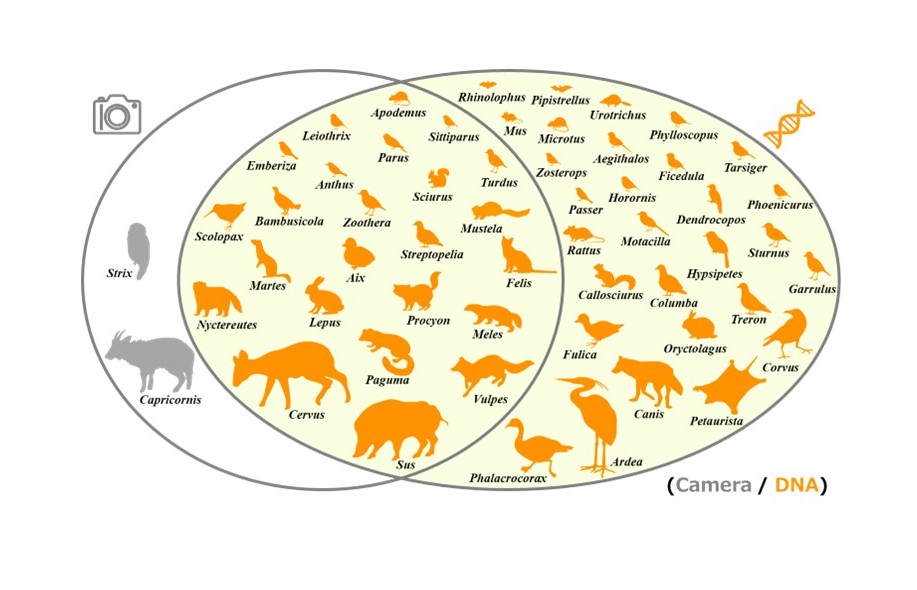
- Figure 2. Overlap between taxa detected by eDNA and recorded by trail cameras.
The team also compared the eDNA results with camera trap observations collected at the same locations. Of the 26 taxa recorded by camera traps, 24 were also detected through eDNA analysis (Figure 2), demonstrating a high level of agreement between the two methods.
The timing of eDNA detections reflected seasonal ecological changes. For instance, the detection of migratory bird taxa, such as Ficedula and Zoothera, which were observed in summer and winter, respectively, closely matched the periods during which they were visually recorded. These results suggest that ground surface eDNA can capture temporal changes in biological communities.
Future Outlook
The Koro-rin method enables efficient collection of eDNA from terrestrial environments by simply rolling a sampler across the ground. The method detected most of the taxa recorded by camera traps and captured the seasonal detection patterns of migratory birds. These findings demonstrate the method's potential for monitoring terrestrial biodiversity.
Because it requires no power source and can be used on various types of ground surfaces, this method is well-suited to repeated sampling at multiple locations. We plan to integrate the Koro-rin method with visual surveys, camera traps, and aquatic eDNA surveys to develop a more comprehensive approach to monitoring biodiversity and ecological change across landscapes.
Toyota Central R&D Labs will continue conducting research to help realize a nature-positive society. Through collaboration with industry, academia, and government, we will conduct validation studies across a broader range of environments and taxonomic groups. We will also work to standardize survey protocols and accelerate the practical application of the method.
Publication Information
Title: A Ground Surface Rolling Method for Detecting Environmental DNA of Terrestrial Animals
Authors: Manami Kakita1, Yoshikazu Furuta1, Hidenori Tanaka1 (1: Toyota Central R&D Labs., Inc.)
Journal: Environmental DNA
Contact
Toyota Central R&D Labs., Inc.
Corporate Communication Sect., Research Promotion Dept.