Seniorfellow
Ryosuke Jinnouchi
Academic Degree :
Dr.Eng.
Research Fields :
Computational Physics, Physical Chemistry
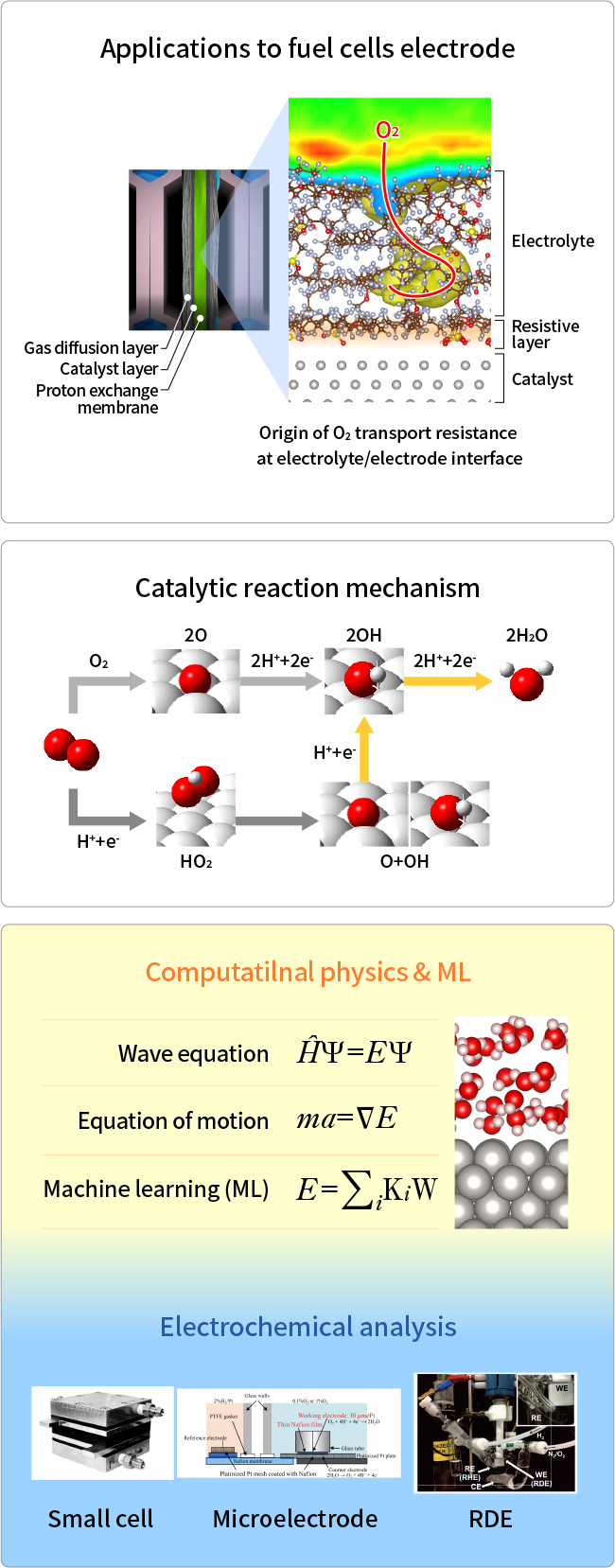
In 1928, Paul Dirac discovered the equation governing fermions in condensed matter. However, in fuel cell research, it is not possible to design high-performance electrode materials based on this equation alone. Using this equation as a starting point, we are designing useful industrial materials, such as electrodes and electrolytes for enhancing the performance of fuel cells. We are also aiming to build computational techniques capable of predicting the performance of devices using these materials. Using first principle calculation and molecular modeling, we have identified the source of interface transport resistance at electrode reaction sites. In addition, to expand the scope of these computations, we have also developed machine learning technology capable of increasing the calculation speeds by 100 to 1,000 times while maintaining accuracy. We are continuing to enhance these computational techniques to enable an integrated approach to phenomena inside electrodes and electrolytes, with the aim of realizing a universal approach to designing the ideal fuel cell.
Jinnouchi, R., Karsai, F. and Kresse, G., “Machine Learning-aided First-principles Calculations of Redox Potentials”, npj Computational Materials, Vol. 10 (2024), 107.
https://doi.org/10.1038/s41524-024-01295-6
Jinnouchi, R., Minami, S., Karsai, F., Verdi, C. and Kresse, G., “Proton Transport in Perfluorinated Ionomer Simulated by Machine-Learned Interatomic Potential”, Journal of Physical Chemistry Letters, Vol. 14 (2023), pp. 3581-3588.
https://doi.org/10.1021/acs.jpclett.3c00293
Jinnouchi, R., “Molecular Dynamics Simulations of Proton Conducting Media Containing Phosphoric acid”, Physical Chemistry Chemical Physics, Vol. 24 (2022), pp. 15522-15531.
https://doi.org/10.1039/d2cp00484d
Jinnouchi, R., Kudo, K., Kodama, K., Kitano, N., Suzuki, T., Minami, S., Shinozaki, K., Hasegawa, N. and Shinohara, A., “The Role of Oxygen-permeable Ionomer for Polymer Electrolyte Fuel Cells”, Nature Communications, Vol. 12 (2021), 4956.
https://doi.org/10.1038/s41467-021-25301-3
Jinnouchi, R., Karsai, F., Verdi, C. and Kresse, G., “First-principles Hydration Free Energies of Oxygenated Species at Water-platinum Interfaces”, Journal of Chemical Physics, Vol. 154 (2021), 094107.
https://doi.org/10.1063/5.0036097
Jinnouchi, R., Karsai, F., Verdi, C., Asahi, R. and Kresse, G., “Descriptors Representing Two- and Three-body Atomic Distributions and Their Effects on the Accuracy of Machine-learned Inter-atomic Potentials”, Journal of Chemical Physics, Vol. 152 (2020), 234102
https://doi.org/10.1063/5.0009491
Jinnouchi, R., Karsai,F. and Kresse, G., “Making Free-energy Calculations Routine: Combining First Principles with Machine Learning”, Physical Review B, Vol. 101 (2020), 060201(R).
https://doi.org/10.1103/PhysRevB.101.060201
Jinnouchi, R., Miwa, K., Karsai, F., Kresse, G. and Asahi, R., “On-the-fly Active Learning of Interatomic Potentials for Large-scale Atomistic Simulations”, Journal of Physical Chemistry Letters, Vol. 11 (2020), pp. 6946–6955.
https://doi.org/10.1021/acs.jpclett.0c01061
Jinnouchi, R., Karsai, F. and Kresse, G., “On-the-fly Machine Learning Force Field Generation: Application to Melting Points”, Physical Review B, Vol. 100 (2019), 014105.
https://journals.aps.org/prb/pdf/10.1103/PhysRevB.100.014105
Jinnouchi, R., Lahnsteiner, J., Karsai, F., Kresse, G. and Bokdam, M., “Phase Transitions of Hybrid Perovskites Simulated by Machine-learning Force Fields Trained on the Fly with Bayesian Inference”, Physical Review Letter, Vol. 122 (2019), 225701.
https://journals.aps.org/prl/abstract/10.1103/PhysRevLett.122.225701
Jinnouchi, R. and Asahi, R., “Predicting Catalytic Activity of Nanoparticles by a DFT-aided Machine-learning Algorithm”, Journal of Physical Chemistry Letters, Vol. 8 (2017), pp. 4279–4283.
https://doi.org/10.1021/acs.jpclett.7b02010