
Senior Fellow
Takeshi Morikawa
Academic Degree
Dr.Eng.
Research Fields
- Photocatalysis
- Photofunctional Materials
- Electrocatalysis
- Energy Conversion
- Jul. 2015 Appointed Senior Fellow of Toyota Central R&D Labs., Inc.
- Sep. 2005 Received a doctoral degree in engineering from Nagoya University
- Apr. 1989 Joined Toyota Central R&D Labs., Inc.
- Mar. 1989 Received a master’s degree from Department of Electrical and Electronic Engineering, Nagoya University
- Mar. 1987 Received a bachelor’s degree from Department of Electrical and Electronic Engineering, Nagoya University
- International Association of Hydrogen Energy (IAHE) Akira Mitsui Award, 2022
- Prize for Science and Technology, The Commendation for Science and Technology by the Minister of Education, Culture, Sports, Science and Technology, 2020
- Outstanding Achievement Award of the Negishi Award, JST Advanced Catalytic Transformation Program for Carbon Utilization (ACT-C) (2018)
- Technical Development Award of the Electrochemical Society of Japan (Tanahashi Award), 2017
- Environment Minister’s Award for Global Warming Prevention Activity (Technological Development and Commercialization Category), Ministry of the Environment, Government of Japan, 2017
- Chunichi Industrial Technology Award, 2010
- The Chemical Society of Japan Award for Technical Development for 2007
- The American Ceramics Society Corporate Environmental Achievement Award, 2006
- CerSJ Awards for achievements in industrial ceramic technology, 2006
- Technology Development Award of Japan Fine Ceramics Association, 2003
IEEE , The Chemical Society of Japan , Catalysis Society of Japan , The Electrochemical Society of Japan , American Chemical Society
4.Ministry of Environment Consignment Project "Syngas (CO + H_{2} ) Production with High Solar-to-chemical
Conversion Efficiency (~10%) by Using Water and CO_{2} from Exhaust Gas as Raw Materials"
Representative, Research theme: Promotion of CO_{2} Cycle Circulation Society.
(Oct. 2018-Mar. 2021)
3.ACT-C (JST) "Advanced Catalytic Transformation Technology Aims at the Contribution to Solving Various Challenges, such as Environment, Energy, and Drug Design"
Principal investigator, Research theme: Development of Photocatalysts for Solar CO_{2} Reduction Utilizing H_{2}O as an Electron Donor and a Proton Source.
(Oct. 2012-Mar. 2018)
2.An Apple (JSPS) "All Nippon Artificial Photosynthesis Project for Living Earth"
Grant-in-Aid for Scientific Research on Innovative Areas of the Japan Society for the Promotion of Science
(Jul. 2012 – Mar. 2017)
1.KAKENHI (JSPS) Japan Society for the Promotion of Science, Grants-in-Aid for Scientific Research
"Development of Band-controlled Iron-copper Oxide Semiconductor Photocatalysts by Anion Doping" No. 22550188
(Apr. 2010 – Mar. 2013)
Other than CO_{2}
NEDO Projects to Support the Development of Industrial Technology
"Project for Highly Functional Housing Materials using Photocatalyst"
Development of Indoor Environment Purification Materials "Safety and Performance Evaluation of Visible Light Responsive Photocatalysts"
(Jul. 2003- Mar. 2006))
Plants harness solar energy to synthesize organic compounds from water (H₂O) and carbon dioxide (CO₂). In this process, solar energy is converted into chemical energy and stored in the resulting organic compounds. Our research focuses on the development of "artificial photosynthesis," which uses artificial systems to convert solar energy into chemical energy. This technology uses light to drive water oxidation to produce oxygen and CO2 reduction to produce useful chemical compounds.
We develop electrode-based systems that combines combine sunlight-absorbing semiconductors with molecular metal complexes that catalyze the conversion of CO2 into useful chemical compounds.
For example, we are developing an “artificial leaf” consisting of a single planar device that efficiently converts solar energy into chemical energy. We are also developing We are also investigating simple artificial photosynthetic systems that use photocatalyst particles suspended in water and offer considerable design flexibility. In addition, we are developing catalysts and semiconductor materials based on readily available, earth-abundant elements such as iron and manganese, with the aim of reducing environmental impact throughout the entire system life cycle.
Through these efforts, we have achieved energy conversion efficiencies exceeding those of natural photosynthesis and are advancing research and development toward future large-scale CO2 utilization.

Metal complexes are one class of catalysts that facilitate the reduction of carbon dioxide (CO2) to useful chemical compounds. These complexes consist of metal centers coordinated by surrounding molecules called ligands. Ligand design can be used to control catalytic reactivity and complex stability, as well as interactions with semiconductor surfaces.
Drawing on our accumulated knowledge of semiconductors and metal complex catalysts (1), we have developed a hybrid photocatalytic system that combines sunlight-absorbing semiconductors with metal complexes capable of efficiently catalyzing CO2 reduction (2-5). Upon illumination, the semiconductors generate electrons and holes, and the electrons are transferred to the metal complexes to drive the reduction of CO2 dissolved in the solution. This combination provides a promising approach to utilizing CO2 through solar-driven chemical reactions.

- Morikawa, T., et al., Applied Physics Letters, Vol. 96 (2010), 142111-1~3.
https://doi.org/10.1063/1.3386532 - Sato, S., Morikawa, T., et al., Angewandte Chemie-International Edition, Vol. 49 (2010), pp. 5101-5105.
https://doi.org/10.1002/anie.201000613 - Arai, T., Sato, S., et al., Chemical Communications, Vol. 46 (2010), pp. 6944-6946.
https://doi.org/10.1039/c0cc02061c - Suzuki, T. M., Nakamura T., et al., Journal of Materials Chemistry, Vol. 22 (2012), pp. 24584-24590.
https://doi.org/10.1039/c2jm33980c - Morikawa, T., Sato, S. Sekizawa, K., Suzuki, T. M., Arai, T. Accounts of Chemical Research, Vol. 5 (2022), pp. 933-943.
https://doi.org/10.1021/acs.accounts.1c00564
We have developed a high-performance hybrid photoelectrochemical technology by integrating semiconductors with a metal complex catalysts (1, 2). This technology has enabled us to create a monolithic electrode device, which is called an “artificial leaf” (3).
Under sunlight illumination, the artificial leaf converts carbon dioxide (CO2) into formic acid (HCOOH) or formate (HCOO-) on one side, while oxygen gas is evolved from water on the opposite surface. The device achieves a solar-to-chemical energy conversion efficiency of 4.6%, comparable to that of natural photosynthesis in plants. Its high efficiency is attributed to a catalyst that enables CO2 reduction at a potential close to the thermodynamic equilibrium potential.

- Sato, S., Arai, T., Morikawa, T., Uemura, K., Suzuki, T.M., Tanaka, H. and Kajino, T., Journal of the American Chemical Society, Vol.133 (2011), pp. 15240-15243.
https://doi.org/10.1021/ja204881d - Arai, T., Sato, S., Kajino, T. and Morikawa, T., Energy & Environmental Science, Vol. 6 (2013), pp. 1274-1282.
https://doi.org/10.1039/c3ee24317f - Arai, T., Sato, S. and Morikawa, T., Energy & Environmental Science, Vol. 8 (2015), pp. 1998-2002.
https://doi.org/10.1039/c5ee01314c
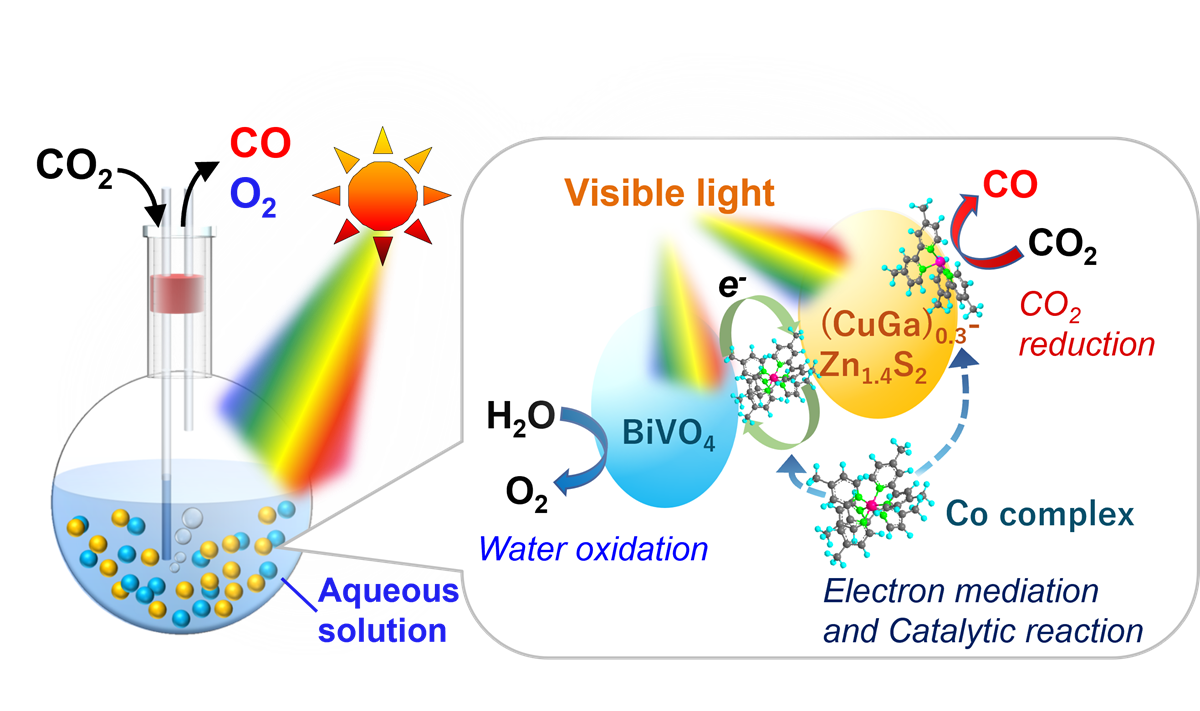
We are developing a simple, scalable artificial photosynthesis system using photocatalyst particles suspended in water. The system combines two types of semiconductor particles: one uses light energy to reduce carbon dioxide (CO₂) into useful chemical compounds, while the other uses light energy to oxidize water and release oxygen. An electron mediator transfers electrons between the two types of particles, linking the reactions through a two-step light-driven process (Z-scheme system) inspired by natural photosynthesis.
Using this system, we have achieved CO₂ reduction together with oxygen production from water (4-5).
This result marks an important step toward artificial photosynthesis systems that use sunlight and water to convert CO₂ into useful chemical resources. This research was conducted in collaboration with the laboratory of Akihiko Kudo at Tokyo University of Science.
- Suzuki, T. M., Yoshino, S., Takayama, T., Iwase, A., Kudo, A. and Morikawa, T., Chem. Commun., Vol. 54 (2018), pp. 10199-10202.
https://doi.org/10.1039/c8cc05505j - Suzuki, T. M., Iwase, A., Tanaka, H., Sato, S., Kudo, A. and Morikawa, T., Journal of Materials Chemistry A, Vol. 3 (2015), pp. 13283-13290.
https://doi.org/10.1039/c5ta02045j - Morikawa, T., et al., ChemSusChem, Vol. 12 (2019), pp. 1807-1824.
https://doi.org/10.1002/cssc.201900441 - Suzuki, T. M., Takayama, T., Sato, S., Iwase, A., Kudo, A. and Morikawa, T., Applied Catalysis B: Environmental, Vol. 224 (2018), pp. 572-578.
https://doi.org/10.1016/j.apcatb.2017.10.053 - Suzuki, T. M., Kudo, A., Yoshino, S., Sekizawa, K., Yamaguchi, Y., Kudo., A., and Morikawa, T., Applied Catalysis B: Environmental, Vol. 316 (2022) pp.121600.
https://doi.org/10.1016/j.apcatb.2022.121600
For artificial photosynthesis to become widely used, we must consider both its energy conversion efficiency and its environmental impact throughout the system’s life cycle. This includes reducing CO₂ emissions and the environmental burden associated with extracting and processing raw materials.
We are developing semiconductor materials and catalysts based on earth-abundant elements such as iron (Fe) and manganese (Mn). By using readily available materials, we aim to reduce reliance on scarce resources and develop more sustainable technologies for converting CO₂ into useful chemicals using sunlight (1-4).
By combining iron- and manganese-based materials with silicon-based solar cells, we have achieved a solar-to-chemical energy conversion efficiency of over 10%. These efforts aim to reduce environmental impact and contribute to a sustainable, circular society(5).

- Morikawa, T., et al., Applied Physics Letters, Vol. 98 (2011), 242108.
https://doi.org/10.1063/1.3599852 - Sato, S., Saita K., Sekizawa K., Maeda S., Morikawa, T., ACS Catalysis, Vol. 8 (2018), pp. 4452-4458.
https://doi.org/10.1021/acscatal.8b01068 - Suzuki, T. M., Nonaka, T., et al., Sustainable Energy & Fuels, Vol. 1 (2017), pp. 636-643.
https://doi.org/10.1039/c7se00043j - Sekizawa, et al, ACS Catalysis, Vol.8 (2018), pp 1405-1416.
https://doi.org/10.1021/acscatal.7b03244 - Arai, T., Sato, S., Sekizawa, K., Suzuki, T. M. and Morikawa, T., Chemical Communications, Vol. 55 (2019), pp. 237-240.
https://doi.org/10.1039/c8cc07900e
Light-driven CO₂ reduction involves several interconnected steps, including light absorption, the generation and transfer of electrons, and reactions involving protons. The efficiency of each step affects the overall performance of the system, yet many details of these processes remain unclear.
To better understand how these reactions proceed, we collaborate with experts in complementary fields to investigate how light absorption, electron generation and transfer, and proton transfer influence CO₂ reduction. These studies help us identify the factors that limit efficiency and guide the development of more effective catalysts and reaction systems. (1-4)
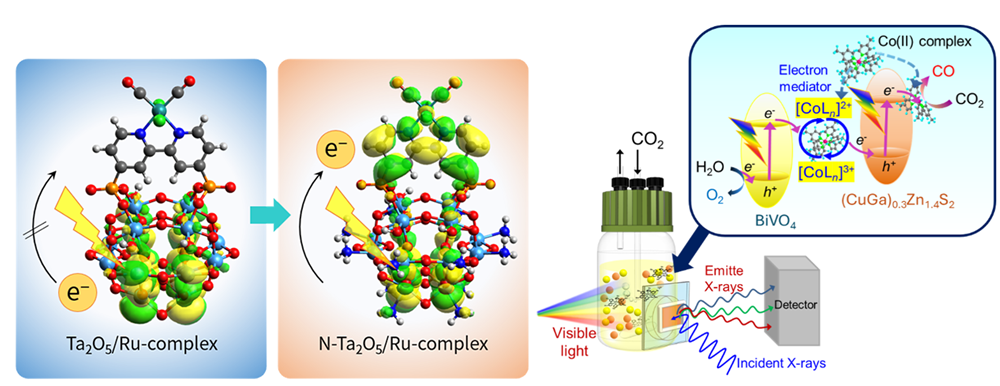
Our research has demonstrated light-driven CO₂ reduction using nitrogen-doped tantalum pentoxide (N–Ta₂O₅) combined with ruthenium (Ru) complexes. Introducing nitrogen into Ta₂O₅ improves CO₂ reduction efficiency in this hybrid system. Experimental studies and computational analyses have helped clarify the complementary roles of the semiconductor and the Ru complex catalyst.
We have also investigated light-driven reactions in aqueous suspensions of zinc oxide particles. These studies show that catalyst concentration strongly influences reaction performance, highlighting the importance of controlling catalyst loading. By examining the relationship between the response to light and CO₂ reduction, we aim to better understand the factors that govern the overall reaction. (5)
These findings provide insights into the reaction mechanism and guide the development of more efficient photocatalytic systems.
- Shirai, S.; Sato, et al., T., Journal of Physical Chemistry C, Vol. 122 (2018) pp. 1921-1929.
https://doi.org/10.1021/acs.jpcc.7b09670 - Yamanaka, K., Sato, et al., T., Journal of Physical Chemistry C, Vol. 115 (2011), pp. 18348-18353.
https://doi.org/10.1021/jp205223k - Sato, S., Onda, K., et al., Chemistry – A European Journal, Vol. 27 (2020), pp. 1127-1137.
https://doi.org/10.1002/chem.202004068 - Morikawa, T., Gul, S., Nishimura, Y.F., Suzuki, T.M. and Yano, J., Chemical Communications, Vol. 56 (2020), pp. 5158-5161.
https://doi.org/10.1039/d0cc00692k - Suzuki, T. M. et al. Chemical Communications, Vol. 61 (2025), pp. 19620-19623.
https://doi.org/10.1039/d5cc05617a
We are working to scale up artificial photosynthesis technology toward its future deployment in society. We have demonstrated CO₂ reduction in systems with electrode areas approximately 1,000 times the original size, and subsequently at 1 m²—approximately 10,000 times the original size—while maintaining high energy conversion efficiency.
These advances in scale-up represent an important step toward bringing artificial photosynthesis from laboratory research into practical use.
“A new leaf unfolds in artificial photosynthesis”, Nature (2022)
We are also working to further advance artificial photosynthesis technology. Specifically, we are developing methods to increase CO₂ conversion rates and directly synthesize higher-value organic compounds, such as alcohols. In addition, we are exploring reactions that transform carbon and other elements simultaneously. Through these efforts, we aim to establish a new technological foundation not only for reducing CO₂ emissions but also for enabling the circular use of a wide range of resources.
Supervised by Toyota Central R&D Labs., Inc. Authored by Takeshi Morikawa
Publication Date: January 19, 2024
ISBN:978-4-274-23152-0
(in Japanese)
- Uyama, T., Lee, J., Sakamoto, N., Nonaka, T., Miyamoto, K., Morikawa, T., “Structure–Activity Relationship in Structurally Diverse Cobalt Oxide Catalysts for the Electrochemical Reduction of Nitrate to Ammonia”, Journal of Physical Chemistry C, Vol.130, (2026) , 11507–11526.
https://doi.org/10.1021/acs.jpcc.6c01709
- Sakamoto, N., Uyama, T., Nonaka, T., Morikawa, T. and Sato, S., “Pre-introduced Alkali-Metal Cations Enhance C2+ Faradaic Efficiency in CO2 Reduction”, Journal of Physics: Energy, Vol. 8, No. 2, (2026), 025005.
https://doi.org/10.1088/2515-7655/ae6140
- Morikawa, T., Suzuki, T. M., Yamaguchi, Y. and Kudo, A., “Photocatalytic CO2 Reduction with a Semiconductor/Metal Complex Hybrid System: Toward Visible Light and Water Utilization”, Journal of Photochemistry and Photobiology C: Photochemistry Reviews, Vol. 66, (2026), 100735.
https://doi.org/10.1016/j.jphotochemrev.2025.10073
- Sakamoto, N., Sekizawa, K., Sato, S., Jung, J., Wakabayashi, T., Kamada, K., Nonaka, T., Uyama, T., Morikawa, T. and Saito, S., “Mechanism of CO2 Electrolysis with Heterogenized Molecular Iridium Catalysts Deciphered Using Operando Spectroscopy”, Journal of the American Chemical Society, (2025).
https://doi.org/10.1021/jacs.5c19250
- Suzuki, T. M., Nonaka, T., Uyama, T., Sakamoto, N., Sekizawa, K., Yamaguchi, Y., Kudo, A. and Morikawa, T., “Direct Observation of an Ionic Cobalt Complex Electron Mediator via Operando X-ray Absorption Spectroscopy in Photocatalytic Z-scheme CO2 Reduction with (CuGa)0.3Zn1.4S2 and BiVO4”, Chemical Communications, Vol. 61, No. 99, (2025), pp. 19620–19623.
https://doi.org/10.1039/D5CC05617A
- Nishi, T., Sakamoto, N., Sekizawa, K., Kosaka, S., Morikawa, T. and Sato, S., “Selective CO2 Reduction in Tap-Water Electrolyte Catalyzed by Impurity-Resistant Mn-Complex Supported on Carbon”, ACS Applied Energy Materials, Vol. 8, No. 15, (2025), pp. 11297–11302.
https://doi.org/10.1021/acsaem.5c01422
- Uyama, T., Noda, Y., Suzuki, T. M., Sekizawa, K., Sakamoto, N., Nonaka, T. and Morikawa, T., “Role of Chloride Ions in the Heat Treatment of β-FeOOH(Cl) Catalysts to Enhance the Oxygen Evolution Reaction Activity”, Chemistry of Materials, Vol. 37, No. 9, (2025), pp. 3327–3342.
https://doi.org/10.1021/acs.chemmater.5c00128
- Jung, J., Lee, K. W., Sakamoto, N., Kaliyamoorthy, S., Wakabayashi, T., Kamada, K., Sekizawa, K., Sato, S., Suzuki, T. M., Morikawa, T. and Saito, S., “Selective Electroreduction of CO2 to Formate by a Heterogenized Ir Complex Using H2O as an Electron/Hydrogen Source”, EES Catalysis, Vol. 3, No. 2, (2024), pp. 254–258.
https://doi.org/10.1039/D4EY00261J
- Takeda, Y. and Morikawa, T., “How to Supply More Solar Energy to Reactive Sites for Highly Efficient Artificial Photosynthesis”, Journal of Physics: Energy, Vol. 7, No. 1, (2024), 012002.
https://doi.org/10.1088/2515-7655/ad97de
- Suzuki, T. M., Nonaka, T., Nishimura, Y. F., Matsuoka, Y., Kosaka, S., Takahashi, N., Kitazumi, K., Oh-ishi, K. and Morikawa, T., “Ni-Doped β-FeOOH Hyperfine Nanorods Surface-Modified with Ni Species Catalyzing Water Oxidation at Neutral pH: Strained FeOOH Core and Phase-Changing Ni(OH)2”, ACS Applied Energy Materials, Vol. 7, No. 21, (2024), pp. 9689–9705.
https://doi.org/10.1021/acsaem.4c01069
- Nishi, T., Sakamoto, N., Sekizawa, K., Morikawa, T. and Sato, S., “CO2-to-CO Conversion with Over 10 % Efficiency Using Earth Abundant System in a Single-Compartment Reactor with Oxygen Tolerant Mn Complex Catalyst”, ChemSusChem, (2024), e202401082.
https://doi.org/10.1002/cssc.202401082
- Sakamoto, N., Sekizawa, K., Shirai, S., Nonaka, T., Arai, T., Sato, S. and Morikawa, T., “Dinuclear Cu(I) Molecular Electrocatalyst for CO2-to-C3 Product Conversion”, Nature Catalysis, Vol. 7, (2024), pp. 574-584.
https://doi.org/10.1038/s41929-024-01147-y
- Kamada, K., Jung, J., Yamada, C., Wakabayashi, T., Sekizawa, K., Sato, S., Morikawa, T., Fukuzumi, S. and Saito, S., “Photocatalytic CO2 Reduction Using an Osmium Complex as a Panchromatic Self-photosensitized Catalyst: Utilization of Blue, Green, and Red Light”, Angewandte Chemie-International Edition, Vol. 63, (2024), e202403886.
https://doi.org/10.1002/anie.20240388
- Sato, S., Sekizawa, K., Shirai, S., Sakamoto, N. and Morikawa, T., “Enhanced Performance of Molecular Electrocatalysts for CO2 Reduction in a flow Cell Following K+ Addition”, Science Advances, Vol. 9, (2023), eadh9986.
https://doi.org/10.1126/sciadv.adh9986
- Suzuki, T. M., Nagatsuka, K., Nonaka, T., Yamaguchi, Y., Sakamoto, N., Uyama, T., Sekizawa, K., Kudo., A. and Morikawa, T., “Highly Selective CO2 Electrolysis in Aqueous Media by a Water-soluble Cobalt Dimethyl-bipyridine Complex”, Chemical Communications, Vol. 59, (2023), pp. 12318-12321.
https://doi.org/10.1039/d3cc03940d
- Bonchio, M., Bonin, J., Ishitani, O., Lu, T. B., Morikawa, T., Morris, A. J., Reisner E., Sarkar, D., Toma, F. M. and Robert, M., “Best Practices for Experiments and Reporting in Photocatalytic CO2 Reduction”, Nature Catalysis, Vol. 6, (2023), pp. 657-665.
https://doi.org/10.1038/s41929-023-00992-7
- Takeda, Y., Mizuno, S., Iwata, R., Morikawa, T. and Kato, N., “Gas-fed Liquid-covered Electrodes Used for Electrochemical Reduction of Dilute CO2 in a Flue Gas”, Journal of CO2 Utilization, Vol. 71, (2023), 102472.
https://doi.org/10.1016/j.jcou.2023.102472
- Takeda, Y., Yamanaka, K., Morikawa, T. and Kato, N., “Design Guides for Artificial Photosynthetic Devices Consisting of Voltage-matched Perovskite/Silicon Tandem Solar-cell Modules and Electrochemical Reactor Modules”, Japanese Journal of Applied Physics, Vol. 62, (2023), SK1018.
https://doi.org/10.35848/1347-4065/acc3a5
- Takeda, Y., Sato, S. and Morikawa, T., “Effects of Impact Ionization and Auger Recombination on Hot-carrier Solar Cells and Hot-carrier Photocatalysts”, Japanese Journal of Applied Physics, Vol. 62, (2023), SK1003.
https://doi.org/10.35848/1347-4065/acbebe
- Yamanaka, K., Sato, K., Sato, S., Nozawa, S., Lee, S., Fukaya, R., Fukuzawa, H., You, D., Saito, S., Takanashi, T., Katayama, T., Togashi, T., Nonaka, T., Dohmae, K., Adachi, S., Ueda, K., Yabashi, M., Morikawa, T. and Asahi, R., “Ultrafast Charge-transfer Dynamics in a Visible-light-excited Iridium(III) Terpyridine 2-phenylpyridine Complex Studied by Femtosecond X-ray Absorption Spectroscopy”, Journal of Photochemistry and Photobiology A: Chemistry, Vol. 435, (2023), 114267.
https://doi.org/10.1016/j.jphotochem.2022.114267
- Takeda, Y., Yamanaka, K., Morikawa, T. and Kato, N., “Artificial Photosynthetic Monolithic Devices Using Voltage-matched Perovskite/Silicon Tandem Photovoltaic Modules”, Journal of Applied Physics, Vol. 132, (2022), 075002.
https://doi.org/10.1063/5.0097485
- Kamada, K., Jung, J., Kametani, Y., Wakabayashi, T., Shiota, Y., Yoshizawa, K., Bae, S. H., Muraki, M., Naruto, M., Sekizawa, K., Sato, S., Morikawa, T. and Saito, S., “Importance of Steric Bulkiness of Iridium Photocatalysts with PNNP Tetradentate Ligands for CO2 Reduction”, Chemical Communications, Vol. 58, (2022), pp. 9218-9221.
https://doi.org/10.1039/d2cc01701f
- Ikeda, T., Suzuki, T. M., Arai, T. and Morikawa, T., “Ni-modified β-FeOOH Nanorod Cocatalysts for Oxygen Evolution Utilising Photoexcited Holes on a N 2p Level in a N-doped TiO2 Electrode”, Chemical Communications, Vol. 58, (2022), pp. 8125-8128.
https://doi.org/10.1039/d2cc02795j
- Suzuki, T. M., Yoshino, S., Sekizawa, K., Yamaguchi, Y., Kudo, A. and Morikawa, T., “Photocatalytic CO2 Reduction by a Z-scheme Mechanism in an Aqueous Suspension of Particulate (CuGa)0.3Zn1.4S2, BiVO4 and a Co Complex Operating Dual-functionally as an Electron Mediator and as a Cocatalyst”, Applied Catalysis B-Environmental, Vol. 316, (2022), 121600.
https://doi.org/10.1016/j.apcatb.2022.121600
- Wakabayashi, T., Kamada, K., Sekizawa, K., Sato, S., Morikawa, T., Jung, J. and Saito, S., “Photocatalytic CO2 Reduction Using an Iron-Bipyridyl Complex Supported by Two Phosphines for Improving Catalyst Durability”, Organometallics, Vol. 41, (2022), pp. 1865-1871
https://doi.org/10.1021/acs.organomet.2c00171
- Takeda, Y., Sato, S. and Morikawa, T., “Hot-carrier Photocatalysts for Artificial Photosynthesis”, Journal of Chemical Physics, Vol. 156, (2022), 164705.
https://doi.org/10.1063/5.0088459
- Yoshino, S., Iwase, A., Yamaguchi, Y., Suzuki, T. M., Morikawa, T. and Kudo, A., “Photocatalytic CO2 Reduction Using Water as an Electron Donor under Visible Light Irradiation by Z-Scheme and Photoelectrochemical Systems over (CuGa)0.5ZnS2 in the Presence of Basic Additives”, Journal of the American Chemical Society, 144, (2022), pp. 2323-2332.
https://doi.org/10.1021/jacs.1c12636
- Morikawa, T., Sato, S., Sekizawa, K., Suzuki, T. M. and Arai, T., “Solar-driven CO2 Reduction Using a Semiconductor/Molecule Hybrid Photosystem: from Photocatalysts to a Monolithic Artificial Leaf”, Accounts of Chemical Research, Vol. 55, (2022), pp. 933-943.
https://doi.org/10.1021/acs.accounts.1c00564
- Kamada, K., Okuwa, H., Wakabayashi, T., Sekizawa, K., Sato, S., Morikawa, T., Jung, J. and Saito, S., “A Highly Durable, Self-photosensitized Mononuclear Ruthenium Catalyst for CO2 Reduction”, Synlett, Vol. 33, (2022), pp. 1137-1141.
https://doi.org/10.1055/a-1709-0280
< Related Article >
- “A new leaf unfolds in artificial photosynthesis”
https://www.nature.com/articles/d42473-021-00577-7
- Kato, N., Takeda, Y., Kawai, Y., Nojiri, N., Shiozawa, M., Mizuno, S., Yamanaka, K., Morikawa, T. and Hamaguchi, T., “Solar Fuel Production from CO2 Using a 1 m-Square-Sized Reactor with a Solar-to-formate Conversion Efficiency of 10.5%”, ACS Sustainable Chemistry & Engineering, Vol. 9, (2021), pp. 16031-16037.
https://doi.org/10.1021/acssuschemeng.1c06390
- Sakamoto, N., Sekizawa, K., Sato, S., Ohashi, M., Nonaka, T., Nishimura, Y. F., Kitazumi K., Morikawa, T. and Arai, T., “Electrochemical CO2 Reduction Improved by Tuning the Cu-Cu Distance in Halogen-bridged Dinuclear Cuprous Coordination Polymers”, Journal of Catalysis, Vol. 404, (2021), pp. 12-17.
https://doi.org/10.1016/j.jcat.2021.09.013
- Nishi, T., Sato, S. and Morikawa, T., “Electrochemical CO2 Reduction to HCOOH Catalyzed by Agn(NO3) n+1 Clusters Prepared by Laser Ablation at the Air-Liquid Interface”, Chemistry Letters, Vol. 50, (2021), pp. 1941-1944.
https://doi.org/10.1246/cl.210483
- Takeda, Y., Suzuki, T. M., Sato, S. and Morikawa, T., “Particulate Photocatalytic Reactors with Spectrum-splitting Function for Artificial Photosynthesis”, Physical Chemistry Chemical Physics, Vol. 23, (2021), pp. 15659-15674.
https://doi.org/10.1039/d1cp00597a
- Nishi, T., Sato, S., Sekizawa, K., Suzuki, T. M., Oh-ishi, K., Takahashi, N., Matsuoka, Y. and Morikawa, T., “Carbon Nanohorn Support for Solar Driven CO2 Reduction to CO Catalyzed by Mn-complex in an All Earth-abundant System”, ChemNanoMat, Vol. 7, (2021), pp. 596-599.
https://doi.org/10.1002/cnma.202100081
- Kato, N., Mizuno, S., Shiozawa, M., Nojiri, N., Kawai, Y., Fukumoto, K., Morikawa, T. and Takeda, Y., “A Large-sized Cell for Solar-driven CO2 Conversion with a Solar-to-formate Conversion Efficiency of 7.2%”, Joule, Vol. 5, (2021), pp.1-19.
https://doi.org/10.1016/j.joule.2021.01.002
- Suzuki, T.M., Ishizaki, T., Kosaka, S., Takahashi, N., Isomura, N., Seki, J., Matsuoka, Y., Oh-ishi, K., Oshima, A., Kitazumi, K., Sekizawa, K. and Morikawa, T., “Electrochemical CO2 Reduction Over Nanoparticles Derived from an Oxidized Cu–Ni Intermetallic Alloy”, Chemical Communications, Vol.56, (2020), pp.15008-15011.
https://doi.org/10.1039/D0CC06130A
- Sato, S., Tanaka, S., Yamanaka, K. I., Saeki, S., Sekizawa, K., Suzuki, T.M., Morikawa, T. and Onda, K., “Study of Excited States and Electron Transfer of Semiconductor‐metal-complex Hybrid Photocatalysts for CO2 Reduction by Using Picosecond Time-resolved Spectroscopies”, Chemistry – A European Journal, Vol.27, (2020) , pp. 1127-1137.
https://doi.org/10.1002/chem.202004068
- Sato, K., Yamanaka, K. I., Nozawa, S., Fukuzawa, H., Katayama, T., Morikawa, T., Nonaka, T., Dohmae, K., Ueda, K., Yabashi, M. and Asahi, R., “Charge Trapping Process in Photoexcited Nitrogen-doped Titanium Oxides”, Inorganic Chemistry, Vol.59, (2020) , pp.10439-10449.
https://doi.org/10.1021/acs.inorgchem.0c00696
- Sakamoto, N., Nishimura, F.Y., Nonaka, T., Ohashi, M., Ishida, N., Kitazumi, K., Kato, Y., Sekizawa, K., Morikawa, T. and Arai, T., “Self-assembled Cuprous Coordination Polymer as a Catalyst for CO2 Electrochemical Reduction into C2 Products”, ACS Catalysis, Vol. 10, (2020), pp.10412-10419.
https://doi.org/10.1021/acscatal.0c01593
- Mukai, K., Suzuki, T.M., Uyama, T., Nonaka, T., Morikawa, T. and Yamada, I., “High-pressure Synthesis of ε-FeOOH from β-FeOOH and Its Application to the Water Oxidation Catalyst”, RSC Advances Vol. 10, (2020) pp.44756-44767.
https://doi.org/10.1039/D0RA09895G
- Kamada, K., Jung, J., Wakabayashi, T., Sekizawa, K., Sato, S., Morikawa, T., Fukuzumi, S. and Saito, S., “Photocatalytic CO2 Reduction Using a Robust Multifunctional Iridium Complex towards the Selective Formation of Formic Acid”, Journal of the American Chemical Society, Vol. 142, No. 23 (2020), pp. 10261-10266.
https://doi.org/10.1021/jacs.0c03097
- Takeda, Y., Morikawa, T. and Kato, N., “Spectrally Robust Series/parallel-connected Triple-junction Photovoltaic Cells Used for Artificial Photosynthesis”, Journal of Applied Physics, Vol. 127, No. 20 (2020), 204503.
https://doi.org/10.1063/5.0006310
- Nishi, T., Sato, S., Ohshima, A., Nakamura, T., Sato, S. and Morikawa, T., “Formation of C2 Organic Molecules From CO2 and H2O by Femtosecond Laser Induced Chemical Reactions in Water”, Japanese Journal of Applied Physics, Vol. 59, No. 5 (2020), 057001.
https://doi.org/10.35848/1347-4065/ab87de
- Morikawa, T., Gul, S., Nishimura, Y.F., Suzuki, T.M. and Yano, J., ”Operando X-ray Absorption Spectroscopy of Hyperfine β-FeOOH Nanorods Modified with Amorphous Ni(OH)2 under Electrocatalytic Water Oxidation Conditions”, Chemical Communications, Vol. 56 (2020), pp. 5158-5161.
https://doi.org/10.1039/D0CC00692K
- Sekizawa, K., Oh-ishi, K. and Morikawa, T., “Photoelectrochemical Water-splitting over a Surface Modified p-type Cr2O3 Photocathode”, Dalton Transactions, Vol. 49 (2020), pp. 659-666.
https://doi.org/10.1039/C9DT04296B
- Morikawa, T., Sato, S., Sekizawa, K., Arai, T. and Suzuki, T. M., "Molecular Catalysts Immobilized on Semiconductor Photosensitizers for Proton Reduction toward Visible-light-driven Overall Water Splitting", ChemSusChem, Vol. 12, No. 9 (2019), pp. 1807-1824.
https://doi.org/10.1002/cssc.201900441
- Sakamoto, Y., Noda, Y., Ohno, K., Koike, K., Fujii, K., Suzuki, T. M., Morikawa, T. and Nakamura, S., "First Principles Calculations of Surface Dependent Electronic Structures: a Study on β-FeOOH and γ-FeOOH", Physical Chemistry Chemical Physics, Vol. 21 (2019), pp. 18486-18494.
https://doi.org/10.1039/C9CP00157C
- Kimura, T., Sato, S., Kataoka, K., Morikawa, T. and Nakamura, D., "Self-assembled Single-crystalline GaN Having a Bimodal Meso/Macropore Structure to Enhance Photoabsorption and Photocatalytic Reactions", ACS Applied Materials & Interfaces, Vol. 11, No. 4 (2019), pp. 4233-4241.
https://doi.org/10.1021/acsami.8b18088
- Arai, T., Sato, S., Sekizawa, K., Suzuki, T. M. and Morikawa, T., “Solar-driven CO2 to CO Reduction Utilizing H2O as an Electron Donor by Earth-abundant Mn-bipyridine Complex and Ni-modified Fe-oxyhydroxide Catalysts Activated in a Single-compartment Reactor”, Chemical Communications, Vol. 55 (2019), pp. 237-240.
https://doi.org/10.1039/c8cc07900e
- Sato, S., Saita, K., Sekizawa, K., Maeda, S. and Morikawa, T., “Low-energy Electrocatalytic CO2 Reduction in Water over Mn-complex Catalyst Electrode Aided by a Nanocarbon Support and K+ Cations”, ACS Catalysis, Vol. 8 (2018), pp. 4452-4458.
https://doi.org/10.1021/acscatal.8b01068
- Suzuki, T. M., Yoshino, S., Takayama, T., Iwase, A., Kudo, A. and Morikawa, T., “Z-schematic and Visible-light-driven CO2 Reduction Using H2O as an Electron Donor by a Particulate Mixture of a Ru-complex/(CuGa)1−xZn2xS2 Hybrid Catalyst, BiVO4 and an Electron Mediator”, Chemical Communications, Vol. 54 (2018), pp. 10199-10202.
https://doi.org/10.1039/C8CC05505J
- Nishi, T., Hayasaka, Y., Nakamura, T., Morikawa, T. and Sato, S., “Core-shell Like Au-Ir Nanoparticles with Spatially Variant Electronic State of Au Synthesized by Femtosecond Laser Irradiation of Solution”, Applied Surface Science, Vol. 457, No. 1 (2018), pp. 1044-1049.
https://doi.org/10.1016/j.apsusc.2018.07.046
- Sato, S., Kataoka, K., Jinnouchi, R., Takahashi, N., Sekizawa, K., Kitazumi, K., Ikenaga, E., Asahi, R. and Morikawa, T., “Band Bending and Dipole Effect at Interface of Metal-nanoparticles and TiO2 Directly Observed by Angular-resolved Hard X-ray Photoemission Spectroscopy”, Physical Chemistry Chemical Physics, Vol. 20 (2018), pp. 11342-11346.
https://doi.org/10.1039/C8CP00551F
- Nishi, T., Hayasaka, Y., Suzuki, T. M., Sato, S., Isomura, N., Takahashi, N., Kosaka, S., Nakamura, T., Sato, S. and Morikawa, T., “Electrochemical Water Oxidation Catalysed by CoO‐Co2O3‐Co(OH)2 Multiphase‐nanoparticles Prepared by Femtosecond Laser Ablation in Water”, ChemistrySelect, Vol. 3, No. 17 (2018), pp. 4979-4984.
https://doi.org/10.1002/slct.201800943
- Sekizawa, K., Sato, S., Arai, T. and Morikawa, T., "Solar-driven Photocatalytic CO2 Reduction in Water Utilizing a Ruthenium Complex Catalyst on p-Type Fe2O3 with a Multiheterojunction", ACS Catalysis, Vol. 8, No. 2 (2018), pp. 1405-1416. http://dx.doi.org/10.1021/acscatal.7b03244
- Shirai, S., Sato, S., Suzuki, T. M., Jinnouchi, R., Ohba, N., Asahi, R. and Morikawa, T., “Effects of Ta2O5 Surface Modification by NH3 on the Electronic Structure of a Ru-Complex/N–Ta2O5 Hybrid Photocatalyst for Selective CO2 Reduction”, Journal of Physical Chemistry C, Vol. 122 (2018), pp. 1921-1929. http://dx.doi.org/10.1021/acs.jpcc.7b09670
- Suzuki, T. M., Takayama, T., Sato, S., Iwase, A., Kudo, A. and Morikawa, T., “Enhancement of CO2 Reduction Activity under Visible Light Irradiation over Zn-based Metal Sulfides by Combination with Ru-complex Catalysts”, Applied Catalysis B: Environmental, Vol. 224 (2018), pp. 572-578. https://doi.org/10.1016/j.apcatb.2017.10.053
- Suzuki, T. M., Nonaka, T., Kitazumi, K., Takahashi, N., Kosaka, S., Matsuoka, Y., Sekizawa, K., Suda, A. and Morikawa, T., “Highly Enhanced Electrochemical Water Oxidation Reaction over Hyperfine β-FeOOH(Cl): Ni Nanorod Electrode by Modification with Amorphous Ni(OH)2”, Bulletin of Chemical Society of Japan, Vol. 91, No. 5 (2018), pp. 778-786. https://doi.org/10.1246/bcsj.20170426
- Sato, S. and Morikawa, T., “[Ir(tpy)(bpy)Cl] as a Photocatalyst for CO2 Reduction under Visible-light Irradiation”, ChemPhotoChem, Vol. 2 (2018), pp. 207-212. http://dx.doi.org/10.1002/cptc.201700133
- Sato, S., Arai, T. and Morikawa, T., “Electrocatalytic CO2 Reduction Near the Theoretical Potential in Water Using Ru Complex Supported on Carbon Nanotubes”, Nanotechnology, Vol. 29, No. 3 (2018), 034001. https://doi.org/10.1088/1361-6528/aa9d50
- Yoshida, H., Sato, M., Fukuo, N., Zhang, L., Yoshida, T., Yamamoto, Y., Morikawa, T., Kajino, T., Sakano, M., Sekito, T., Matsumoto, S. and Hirata, H., “Sodium Hexatitanate Photocatalysts Prepared by a Flux Method for Reduction of Carbon Dioxide with Water”, Catalysis Today, Vol. 303 (2018), pp. 296-304. https://doi.org/10.1016/j.cattod.2017.09.029
- Suzuki, T. M., Saeki, S., Sekizawa, K., Kitazumi, K., Takahashi, N. and Morikawa, T., “Photoelectrochemical Hydrogen Production by Water Splitting over Dual-functionally Modified Oxide: p-Type N-doped Ta2O5 Photocathode Active under Visible Light Irradiation”, Applied Catalysis B: Environmental, Vol. 202 (2017), pp. 597-604. https://doi.org/10.1016/j.apcatb.2016.09.066
- Suzuki, T. M., Nonaka, T., Suda, A., Suzuki, N., Matsuoka, Y., Arai, T., Sato, S. and Morikawa, T., “Highly Crystalline β-FeOOH(Cl) Nanorod Catalysts Doped with Transition Metals for Efficient Water Oxidation”, Sustainable Energy & Fuels, Vol. 1, No. 3 (2017), pp. 636-643. https://doi.org/10.1039/C7SE00043J
- Sekizawa, K., Oh-ishi, K., Kataoka, K., Arai, T., Suzuki, T. M. and Morikawa, T., "Stoichiometric Water Splitting using a p-type Fe2O3 Based Photocathode with the Aid of a Multi-heterojunction", Journal of Materials Chemistry A, Vol. 5, No. 14 (2017), pp. 6483-6493. http://dx.doi.org/10.1039/C7TA00431A
< Related Paper >
- Morikawa, T., Sato, S. and Arai, T., “Chapter 7: Light-driven Carbon Dioxide Reduction Devices”, Molecular Devices for Solar Energy Conversion and Storage, Ed. by Tian, H., Boschloo, G. and Hagfeldt, A. (2017), pp. 259-280, Springer International Publishing. https://doi.org/10.1007/978-981-10-5924-7_7
- Arai, T., Sato, S. and Morikawa, T., “Aminoalkylsilane-modified Silver Cathodes for Electrochemical CO2 Reduction”, Chemistry Letters, Vol. 45 (2016), pp. 1362-1364. https://doi.org/10.1246/cl.160685
- Sato, S. Arai, T. and Morikawa, T., “Carbon Microfiber Layer as Noble Metal-catalyst Support for Selective CO2 Photoconversion in Phosphate Solution: Toward Artificial Photosynthesis in a Single-compartment Reactor”, Journal of Photochemistry and Photobiology A -Chemistry, Vol. 327, No. 1 (2016), pp. 1-5. https://doi.org/10.1016/j.jphotochem.2016.04.017
- Ohwaki, T. Saeki, S. Aoki, K. and Morikawa, T., “Evaluation of Photocatalytic Activities and Characteristics of Cu- or Fe-modified Nitrogen-doped Titanium Dioxides for Applications in Environmental Purification”, Japanese Journal of Applied Physics, Vol.55, No. 1 (2016), pp. 01AA05. http://doi.org/10.7567/JJAP.55.01AA05
< Related Paper >
- Morikawa, T., “CO2 Reduction by Photoelectrochemistry”, Solar to Chemical Energy Conversion Ed. by Sugiyama, M., Fujii, K. and Nakamura, S. (2016), pp. 281-296, Springer International Publishing, Switzerland.
- Arai, T., Sato, S. and Morikawa, T., "A Monolithic Device for CO2 Photoreduction to Generate Liquid Organic Substances in a Single-compartment Reactor", Energy & Environmental Science, Vol. 8, No. 7 (2015), pp. 1998-2002. http://dx.doi.org/10.1039/c5ee01314c
- Yoshida, H., Zhang, L.K., Sato, M., Morikawa, T., Kajino, T., Sekito, T., Matsumoto, S. and Hirata, H., "Calcium Titanate Photocatalyst Prepared by a Flux Method for Reduction of Carbon Dioxide with Water", Catalysis Today, Vol. 251 (2015), pp. 132-139. http://dx.doi.org/10.1016/j.cattod.2014.10.039
- Sato, S., Arai, T. and Morikawa, T., "Toward Solar-driven Photocatalytic CO2 Reduction Using Water as an Electron Donor", Inorganic Chemistry, Vol. 54, No. 11 (2015), pp. 5105-5113. http://dx.doi.org/10.1021/ic502766g
- Sahara, G., Abe, R., Higashi, M., Morikawa, T., Maeda, K., Ueda, Y. and Ishitani, O., "Photoelectrochemical CO2 Reduction Using a Ru(II)-Re(I) Multinuclear Metal Complex on a p-type Semiconducting NiO Electrode", Chemical Communications, Vol. 51, No. 53 (2015), pp. 10722-10725. http://dx.doi.org/10.1039/c5cc02403j
- Suzuki, T. M., Iwase, A., Tanaka, H., Sato, S., Kudo, A. and Morikawa, T., "Z-scheme Water Splitting under Visible Light Irradiation over Powdered Metal-complex/semiconductor Hybrid Photocatalysts Mediated by Reduced Graphene Oxide", Journal of Materials Chemistry A, Vol. 3, No. 25 (2015), pp. 13283-13290. http://dx.doi.org/10.1039/c5ta02045j
< Related Papers >
- Garg, K., Matsubara, Y., Ertem, M. Z., Lewandowska-Andralojc, A., Sato, S., Szalda, D. J., Muckerman, J. T. and Fujita, E., "Striking Differences in Properties of Geometric Isomers of [Ir(tpy)(ppy)H]+ : Experimental and Computational Studies of their Hydricities, Interaction with CO2 , and Photochemistry", Angewandte Chemie International Edition Paper, in press. http://dx.doi.org/10.1002/anie.201506961
- Akimov, A. V., Asahi, R., Jinnouchi, R. and Prezhdo, O. V., "What Makes the Photocatalytic CO2 Reduction on N-Doped Ta2O5 Efficient: Insights from Nonadiabatic Molecular Dynamics", Journal of the American Chemical Society, Vol. 137, No. 35(2015), pp. 11517-11525. http://dx.doi.org/10.1021/jacs.5b07454
- Asahi, R., Morikawa, T., Irie, H. and Ohwaki, T., "Nitrogen-Doped Titanium Dioxide as Visible-Light-Sensitive Photocatalyst: Designs, Developments, and Prospects", Chemical Reviews, Vol. 114, No. 19 (2014), pp. 9824-9852. http://dx.doi.org/10.1021/cr5000738
- Sekizawa, K., Nonaka, T., Arai, T. and Morikawa, T., "Structural Improvement of CaFe2O4 by Metal Doping toward Enhanced Cathodic Photocurrent", Acs Applied Materials & Interfaces, Vol. 6, No. 14 (2014), pp. 10969-10973. http://dx.doi.org/10.1021/am502500y
- Suzuki, T. M., Kitahara, G., Arai, T., Matsuoka, Y. and Morikawa, T., "Nitrogen and Transition-metal Codoped Titania Nanotube Arrays for Visible-light-sensitive Photoelectrochemical Water Oxidation", Chemical Communications, Vol. 50, No. 57 (2014), pp. 7614-7616. http://dx.doi.org/10.1039/c4cc02571g
< Related Papers >
- Akimov, A. V., Jinnouchi, R., Shirai, S., Asahi, R. and Prezhdo O. V., " Theoretical Insights into the Impact of Ru Catalyst Anchors on the Efficiency of Photocatalytic CO2 Reduction on Ta2O5", Journal of Physical Chemistry B, Vol. 119, No. 24(2014), pp.7186-7197. http://dx.doi.org/10.1021/jp5080658
- Yamanaka, K., Ohwaki, T. and Morikawa, T., "Charge-carrier Dynamics in Cu- or Fe-loaded Nitrogen-doped TiO2 Powder Studied by Femtosecond Diffuse Reflectance Spectroscopy", Journal of Physical Chemistry C, Vol. 117, No. 32 (2013), pp. 16448-16456. http://dx.doi.org/10.1021/jp404431z
- Morikawa, T., Arai, T. and Motohiro, T., "Photoactivity of p-Type alpha-Fe2O3 Induced by Anionic/Cationic Codoping of N and Zn", Applied Physics Express, Vol. 6, No. 4 (2013). http://dx.doi.org/10.7567/APEX.6.041201
- Arai, T., Sato, S., Kajino, T. and Morikawa, T., "Solar CO2 Reduction Using H2O by a Semiconductor/metal-complex Hybrid Photocatalyst: Enhanced Efficiency and Demonstration of a Wireless System Using SrTiO3 Photoanodes", Energy & Environmental Science, Vol. 6, No. 4 (2013), pp. 1274-1282. http://dx.doi.org/10.1039/c3ee24317f
- Morikawa, T., Sato, S., Arai, T., Uemura, K., Yamanaka, K.I., Suzuki, T. M., Kajino, T. and Motohiro, T., "Selective CO2 Reduction Conjugated with H2O Oxidation Utilizing Semiconductor/Metal-Complex Hybrid Photocatalysts", Solar Chemical Energy Storage (Solches), Vol. 1568 (2013), pp. 11-15. http://dx.doi.org/10.1063/1.4848080
- Sato, S., Morikawa, T., Kajino, T. and Ishitani, O., "A Highly Efficient Mononuclear Iridium Complex Photocatalyst for CO2 Reduction under Visible Light", Angewandte Chemie-International Edition, Vol. 52, No. 3 (2013), pp. 988-992. http://dx.doi.org/10.1002/anie.201206137
- Suzuki, T. M., Nakamura, T., Saeki, S., Matsuoka, Y., Tanaka, H., Sato, S., Yano, K., Kajino, T. and Morikawa, T., "Novel Hybrid Photocatalyst for Visible-light-sensitive CO2 Reduction; Direct Assembly Synthesis of a Metal-complex on Spherical Mesoporous Semiconductor", R&D Rev. Toyota CRDL, Vol. 44, No. 3, pp. 63-72.
- Yamanaka, K and Morikawa, T., "Charge-carrier Dynamics in Nitrogen-Doped TiO2 Powder Studied by Femtosecond Time-Resolved Diffuse Reflectance Spectroscopy", Journal of Physical Chemistry C, Vol. 116, No. 1 (2012), pp. 1286-1292. http://dx.doi.org/10.1021/jp209210u
- Suzuki, T. M., Nakamura, T., Saeki, S., Matsuoka, Y., Tanaka, H., Yano, K., Kajino, T. and Morikawa, T., "Visible Light-sensitive Mesoporous N-doped Ta2O5 Spheres: Synthesis and Photocatalytic Activity for Hydrogen Evolution and CO2 Reduction", Journal of Materials Chemistry, Vol. 22, No. 47 (2012), pp. 24584-24590. http://dx.doi.org/10.1039/c2jm33980c
- Kajino, T., Morikawa, T., Sato, S., Arai, T., Suzuki,T. M., Uemura, K., Yamanaka, K., Saeki, S. and Tanaka, H., “Direct Synthesis of Organic Compounds from CO2, Water and Sunlight”, R&D Rev. Toyota CRDL, Vol. 43, No. 2, pp. 43-52.
- Sato, S., Arai, T., Morikawa, T., Uemura, K., Suzuki, T. M., Tanaka, H. and Kajino, T., "Selective CO2 Conversion to Formate Conjugated with H2O Oxidation Utilizing Semiconductor/Complex Hybrid Photocatalysts", Journal of the American Chemical Society, Vol. 133, No. 39 (2011), pp. 15240-15243. http://dx.doi.org/10.1021/ja204881d
- Yamanaka, K., Sato, S., Iwaki, M., Kajino, T. and Morikawa, T., "Photoinduced Electron Transfer from Nitrogen-Doped Tantalum Oxide to Adsorbed Ruthenium Complex", Journal of Physical Chemistry C, Vol. 115, No. 37 (2011), pp. 18348-18353. http://dx.doi.org/10.1021/jp205223k
- Morikawa, T., Kitazumi, K., Takahashi, N., Arai, T. and Kajino, T., "p-type Conduction Induced by N-doping in alpha-Fe2O3", Applied Physics Letters, Vol. 98, No. 24 (2011), 242108. http://dx.doi.org/10.1063/1.3599852
- Suzuki, T. M., Tanaka, H., Morikawa, T., Iwaki, M., Sato, S., Saeki, S., Inoue, M., Kajino, T. and Motohiro, T., "Direct Assembly Synthesis of Metal Complex-semiconductor Hybrid Photocatalysts Anchored by Phosphonate for Highly Efficient CO2 Reduction", Chemical Communications, Vol. 47, No. 30 (2011), pp. 8673-8675. http://dx.doi.org/10.1039/c1cc12491a
- Arai, T., Tajima, S., Sato, S., Uemura, K., Morikawa, T. and Kajino, T., "Selective CO2 Conversion to Formate in water Using a CZTS Photocathode Modified with a Ruthenium Complex Polymer", Chemical Communications, Vol. 47, No. 47 (2011), pp. 12664-12666. http://dx.doi.org/10.1039/c1cc16160a
- Morikawa, T., Suzuki, K., Masaki, H., Ito, T., Kitazumi, K., Takahashi, N., Aoki, K., Asahi, R. and Ohwaki T., “Enhanced Visible-light Photocatalysis over N-doped TiO2 by Loading with Fe, Cu, or Pt Cocatalysts”, R&D Rev. Toyota CRDL, Vol. 42, No. 2, pp. 47-53.
- Katoh, R., Furube, A., Yamanaka, K. and Morikawa, T., "Charge Separation and Trapping in N-Doped TiO2 Photocatalysts: A Time-resolved Microwave Conductivity Study", Journal of Physical Chemistry Letters, Vol. 1, No. 22 (2010), pp. 3261-3265. http://dx.doi.org/10.1021/jz1011548
- Arai, T., Sato, S., Uemura, K., Morikawa, T., Kajino, T. and Motohiro, T., "Photoelectrochemical Reduction of CO2 in Water under Visible-light Irradiation by a p-type InP Photocathode Modified with an Electropolymerized Ruthenium Complex", Chemical Communications, Vol. 46, No. 37 (2010), pp. 6944-6946. http://dx.doi.org/10.1039/c0cc02061c
- Sugiyama, Y., Okamoto, H., Mitsuoka, T., Morikawa, T., Nakanishi, K., Ohta, T. and Nakano, H., "Synthesis and Optical Properties of Monolayer Organosilicon Nanosheets", Journal of the American Chemical Society, Vol. 132, No. 17 (2010), pp. 5946-5947. http://dx.doi.org/10.1021/ja100919d
- Morikawa, T., Saeki, S., Suzuki, T., Kajino, T. and Motohiro, T., "Dual Functional Modification by N Doping of Ta2O5: p-type Conduction in Visible-light-activated N-doped Ta2O5", Applied Physics Letters, Vol. 96, No. 14 (2010), 14211. http://dx.doi.org/10.1063/1.3386532
- Sato, S., Morikawa, T., Saeki, S., Kajino, T. and Motohiro, T., "Visible-light-induced Selective CO2 Reduction Utilizing a Ruthenium Complex Electrocatalyst Linked to a p-Type Nitrogen-Doped Ta2O5 Semiconductor", Angewandte Chemie-International Edition, Vol. 49, No. 30 (2010), pp. 5101-5105. http://dx.doi.org/10.1002/anie.201000613
- Yoshinaga, M., Yamamoto, K., Sato, N., Aoki, K., Morikawa, T. and Muramatsu, A., "Remarkably Enhanced Photocatalytic Activity by Nickel Nanoparticle Deposition on Sulfur-doped Titanium Dioxide Thin Film", Applied Catalysis B-Environmental, Vol. 87, No. 3/4 (2009), pp. 239-244. http://dx.doi.org/10.1016/j.apcatb.2008.08.023
- Nakano, Y., Saeki, S. and Morikawa, T., "Optical Bandgap Widening of p-type Cu2O Films by Nitrogen Doping", Applied Physics Letters, Vol. 94, No. 2 (2009), 02211. http://dx.doi.org/10.1063/1.3072804
- Morikawa, T., Ohwaki, T., Suzuki, K.I., Moribe, S. and Tero-Kubota, S., "Visible-light-induced Photocatalytic Oxidation of Carboxylic Acids and Aldehydes Over N-doped TiO2 Loaded with Fe, Cu or Pt", Applied Catalysis B-Environmental, Vol. 83, No. 1/2 (2008), pp. 56-62. http://dx.doi.org/10.1016/j.apcatb.2008.01.034
- Yin, S., Liu, B., Zhang, P.L., Morikawa, T., Yamanaka, K. and Sato, T., "Photocatalytic Oxidation of NOx under Visible LED Light Irradiation over Nitrogen-doped Titania Particles with Iron or Platinum Loading", Journal of Physical Chemistry C, Vol. 112, No. 32 (2008), pp. 12425-12431. http://dx.doi.org/10.1021/jp803371s
- Asahi, R., Morikawa, T., Hazama, H. and Matsubara, M., "Materials Design and Development of Functional Materials for Industry", Journal of Physics-Condensed Matter, Vol. 20, No. 6 (2008). http://dx.doi.org/10.1088/0953-8984/20/6/064227
- Nakano, Y., Noda, K., Fujikawa, H. and Morikawa, T., "Emissive Interface States in organic Light-emitting Diodes based on Tris(8-hydroxyquinoline) Aluminum", Japanese Journal of Applied Physics, Vol. 47, No. 1 (2008), pp. 464-467. http://dx.doi.org/10.1143/JJAP.47.464
- Nakano, Y., Morikawa, T., Ohwaki, T. and Taga, Y., "Origin of Visible-light Sensitivity in N-doped TiO2 Films", Chemical Physics, Vol. 339, No. 1/3 (2007), pp. 20-26. http://dx.doi.org/10.1016/j.chemphys.2007.05.031
- Asahi, R. and Morikawa, T., "Nitrogen Complex species and Its Chemical Nature in TiO2 for Visible-light Sensitized Photocatalysis", Chemical Physics, Vol. 339, No. 1/3 (2007), pp. 57-63. http://dx.doi.org/10.1016/j.chemphys.2007.07.041
- Nakano, Y., Noda, K., Fujikawa, H. and Morikawa, T., "Deep-level Characterization of Emissive Interface States in Alq(3)-based OLEDs", Physica Status Solidi-Rapid Research Letters, Vol. 1, No. 5 (2007), pp. 196-198. http://dx.doi.org/10.1002/pssr.200701155
- Yoshinaga, M., Takahashi, H., Yamamoto, K., Muramatsu, A. and Morikawa, T., "Formation of Metallic Ni Nanoparticles on Titania Surfaces by Chemical Vapor Reductive Deposition Method", Journal of Colloid And Interface Science, Vol. 309, No. 1 (2007), pp. 149-154. http://dx.doi.org/10.1016/j.jcis.2007.01.051
- Nakano, Y., Noda, K., Fujikawa, H., Morikawa, T. and Ohwaki, T., "Deep-level Characterization of Tris(8-hydroxyquinoline) Aluminum with and without Quinacridone Doping", Japanese Journal of Applied Physics Part 1-Regular Papers Brief Communications & Review Papers, Vol. 46, No. 4B (2007), pp. 2636-2639. http://dx.doi.org/10.1143/JJAP.46.2636
- Nakano, Y., Morikawa, T. and Ohwaki, T., "Visible-light Sensitivity in N-doped ZnO Films Prepared by Reactive Magnetron Sputtering", Zinc Oxide And Related Materials, Vol. 957 (2007), pp. 289-294.
- Morikawa, T., Irokawa, Y. and Ohwaki, T., "Enhanced Photocatalytic Activity of TiO2-xNx Loaded with Copper Ions under Visible Light Irradiation", Applied Catalysis A-General, Vol. 314, No. 1 (2006), pp. 123-127. http://dx.doi.org/10.1016/j.apcata.2006.08.011
- Nakano, Y., Noda, K., Fujikawa, H., Morikawa, T., Ohwaki, T. and Taga, Y., "Trap Levels in Tris(8-hydroxyquinoline) Aluminum Studied by Deep-level Optical Spectroscopy", Applied Physics Letters, Vol. 88, No. 25 (2006), 252104. http://dx.doi.org/10.1063/1.2214179
- Aoki, K., Morikawa, T., Ohwaki, T. and Taga, Y., "Photocatalytic Degradation of Formaldehyde and Toluene Mixtures in Air with a Nitrogen-doped TiO2 Photocatalyst", Chemistry Letters, Vol. 35, No. 6 (2006), pp. 616-617. http://dx.doi.org/10.1246/cl.2006.616
- Nakano, Y., Morikawa, T., Ohwaki, T. and Taga, Y., "Electrical Characterization of p-type N-doped ZnO Films Prepared by Thermal Oxidation of Sputtered Zn3N2 Films", Applied Physics Letters, Vol. 88, No. 17 (2006), 172103. http://dx.doi.org/10.1063/1.2198489
- Nakano, Y., Morikawa, T., Ohwaki, T. and Taga, Y., "Band-gap Narrowing of TiO2 Films Induced by N-doping", Physica B-Condensed Matter, Vol. 376 (2006), pp. 823-826. http://dx.doi.org/10.1016/j.physb.2005.12.206
- Irokawa, Y., Morikawa, T., Aoki, K., Kosaka, S., Ohwaki, T. and Taga, Y., "Photodegradation of Toluene over TiO2-xNx under Visible Light Irradiation", Physical Chemistry Chemical Physics, Vol. 8, No. 9 (2006), pp. 1116-1121. http://dx.doi.org/10.1039/b517653k
- Nakano, Y., Morikawa, T., Ohwaki, T. and Taga, Y., "Deep-level Characterization of N-doped ZnO Films Prepared by Reactive Magnetron Sputtering", Applied Physics Letters, Vol. 87, No. 23 (2005), 232104. http://dx.doi.org/10.1063/1.2139852
- Nakano, Y., Morikawa, T., Ohwaki, T. and Taga, Y., "Electrical Characterization of Band Gap States in C-doped TiO2 Films", Applied Physics Letters, Vol. 87, No. 5 (2005), 052111. http://dx.doi.org/10.1063/1.2008376
- Nakano, Y., Morikawa, T., Ohwaki, T. and Taga, Y., "Deep-level Optical Spectroscopy Investigation of N-doped TiO2 Films", Applied Physics Letters, Vol. 86, No. 13 (2005), 132104. http://dx.doi.org/10.1063/1.1896450
- Morikawa, T., Asahi, R., Ohwaki, T., Aoki, K., Suzuki, K. and Taga, Y., "Visible-light Photocatalyst - Nitrogen-doped Titanium Dioxide – ", R&D Rev. Toyota CRDL, Vol. 40, No. 3, pp. 45-50.
- Nonomura, Y., Fujiyoshi, M., Omura, Y., Tsukada, K., Okuwa, M., Morikawa, T., Sugitani, N., Satou, S. and Kurata, N., "Quartz Rate Gyro Sensor for Automotive Control", Sensors and Actuators A-Physical, Vol. 110, No. 1/3 (2004), pp. 136-141. http://dx.doi.org/10.1016/j.sna.2003.10.048
- Nakamura, T., Morikawa T., Ohwaki, T. and Taga, Y., "Photocatalytic Activity of Sulfur-Doped TiO2 Prepared via Thio Sol-Gel Process", Journal of the Ceramic Society of Japan, Supplement, Vol.112, (2004), S1422-S1424. http://doi.org/10.14852/jcersjsuppl.112.0.S1422.0
- Asahi, R., Morikawa, T., Ohwaki, T., Aoki, K. and Taga, Y., "Photocatalysts Sensitive to Visible Light - response", Science, Vol. 295, No. 5555 (2002), pp. 627-627. http://dx.doi.org/10.1126/science.1061051
- Asahi., R, Morikawa., T, Ohwaki., T, Aoki., K. and Taga, Y., "Visible-light Photocatalysis in Nitrogen-doped Titanium Oxides", Science, Vol. 293, No. 5528 (2001), pp. 269-271. http://dx.doi.org/10.1126/science.1061051
- Morikawa, T., Asahi, R., Ohwaki, T., Aoki, K. and Taga, Y., "Band-gap Narrowing of Titanium Dioxide by Nitrogen Doping", Japanese Journal of Applied Physics Part 2-Letters, Vol. 40, No. 6A (2001), pp. L561-L563. http://dx.doi.org/10.1143/JJAP.40.L561
- Morikawa, T., Suzuki, M. and Taga, Y., "Magnetic Properties of Granular Fe-Cr-O and Fe-X-Cr-O (X = Cu, Rh films)", Japanese Journal of Applied Physics Part 1-Regular Papers Short Notes & Review Papers, Vol. 38, No. 2A (1999), pp. 718-721. http://dx.doi.org/10.1143/JJAP.38.718
- Morikawa, T., Suzuki, M. and Taga, Y., "Improvement of Soft Magnetic Properties of Co-Cr-O film by Additional X(= Rh, Ir, Ag, or Au)", Japanese Journal of Applied Physics Part 2-Letters, Vol. 37, No. 7B (1998), pp. L866-L868. http://dx.doi.org/10.1143/JJAP.37.L866
- Morikawa, T., Suzuki, M. and Taga, Y., "Soft Magnetic Properties of Co-Cr-O Granular Films", Journal of Applied Physics, Vol. 83, No. 11 (1998), pp. 6664-6666. http://dx.doi.org/10.1063/1.367654
- Morikawa, T., Nishibe, Y., Yamadera, H., Nonomura, Y., Takeuchi, M. and Taga, Y., "Giant Magneto-impedance Effect in Layered Thin Films", IEEE Transactions On Magnetics, Vol. 33, No. 5 (1997), pp. 4367-4372. http://dx.doi.org/10.1109/20.620448
- Morikawa, T., Nishibe, Y., Yamadera, H., Nonomura, Y., Takeuchi, M., Sakata, J. and Taga, Y., "Enhancement of Giant Magneto-impedance in Layered Film by Insulator Separation", IEEE Transactions On Magnetics, Vol. 32, No. 5 (1996), pp. 4965-4967. http://dx.doi.org/10.1109/20.539303