R&D Review


How can corporate research institutes consistently produce meaningful research outcomes? Through operating a research dissemination platform, we tackle this challenge every day.
Toyota Central R&D Labs., Inc. was established as the central research institute of the Toyota Group through joint investment by nine group companies. Operating as an independent company rather than a division of a single company, it represents a rare model among corporate research institutes. As a member of the Administration Department, I am engaged in research support activities aimed at broadly disseminating the company’s core product—its research outcomes—to the world.
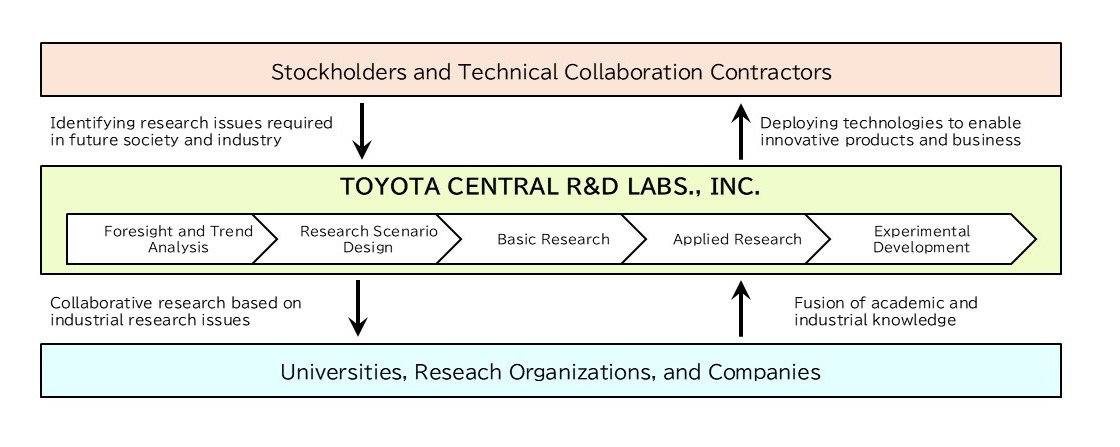
Our company covers a wide range of activities, from surveys and planning to fundamental research and applied research aimed at practical application in society (Figure 1). Although we are a corporate research institute, we are able to engage in early-stage research because our founding philosophy is “We contribute to human prosperity through the formation of industries resulting from original research and actualization.” This philosophy leads us to place equal emphasis not only on research that directly contributes to industry, but also on research that lays the groundwork for future industrial contributions. At this stage, we collaborate with external research institutions, such as universities, to sow the seeds for future innovation.
- 拡大
- Figure 1. Toyota Central R&D Labs.' research and development framework, spanning a broad range of R&D phases and research fields.
The research outcomes we generate are ultimately intended for implementation in society through the products and services of Toyota Group companies. Because the Toyota Group—centered on automobiles—operates across many fields, our research areas are equally diverse. Covering a broad range of R&D phases and research fields is one of our defining characteristics.
To ensure that these distinctive research activities proceed smoothly, robust research support functions are essential. While research support encompasses many approaches, my primary responsibilities involve planning and managing initiatives that promote our technologies to shareholders and technical partners, including Toyota Group companies. I also act as a liaison, connecting our researchers and engineers with external partners to advance collaboration within the group. Although I am neither a researcher nor an engineer myself, I share the same passion for “making the world a better place through research and technology.” Through these diverse responsibilities, I continually explore better ways to deliver our research outcomes to the world.
Recently, I served as project leader for “CHUKEN EXPO,” an event designed to deepen shareholders and technical collaboration contractors’ understanding of our research activities. The EXPO invites researchers and engineers from the stakeholder company to our facilities, where we present our latest research findings through poster sessions and prototype demonstrations. For us, as the central research institute of the Toyota Group, publishing our research in academic journals is only the first step toward creating value. Introducing our research initiatives to group companies is also a critical mission—one that helps address immediate challenges while sparking ideas for future business opportunities. In this sense, the EXPO functions as an indispensable platform, creating a “space for connection” with the stakeholder companies.
As project leader, I placed particular emphasis on how to communicate our research outcomes in a more compelling way. Because the purpose of the EXPO is not only to deepen relationships with existing contacts but also to help those unfamiliar with our work understand it, I believed it was essential to go beyond simple research introductions and find ways to clearly convey its value.
To achieve this, I felt it was crucial for the planning team to understand the broader context behind each research theme and to design the event so that research would be presented together with a compelling narrative. If each researcher simply reported on the progress of their own work, as they would at an academic conference, each study would be communicated as an isolated “point.” Instead, we aimed to connect individual research activities into a coherent “line”—telling the story of what societal challenges exist, how Toyota Group companies are working to address them, and why our company is pursuing particular research topics. We believed this approach would make it easier for participants to understand the significance and value of engaging with our research.
We aligned stakeholders around this perspective and applied it to selecting presentation themes, designing category classifications that reflected the overall story, and planning the venue layout. The year I served as project leader marked the first in-person EXPO in five years following the pandemic, presenting challenges distinct from previous online editions. Nevertheless, the event achieved the highest attendance in its history. Moreover, the number of inquiries received afterward—one indicator of how effectively we communicated our research—reached an unprecedented level. I am confident that our efforts were successful, and we will continue refining the EXPO to make it an even more meaningful place for connection.
While working on initiatives such as operating the EXPO research dissemination platform, I gradually began to approach research support from a broader perspective. Previously, my primary focus was on ensuring that the new technologies and other outcomes generated by our research activities were utilized in society through the businesses of our group companies. However, from a management standpoint, I came to realize that it is equally important to create a virtuous cycle—one in which the use of our technologies not only benefits others, but also deepens their understanding of our company, improves our research environment, and helps attract outstanding talent. Looking ahead, I want to challenge myself to help build a research environment in which our company can continue to generate innovative results.
Whether it involves deepening understanding among group companies to improve research environments or engaging the broader research community to attract new researchers, I believe the essential question ultimately becomes: “Can I convey our company’s appeal in my own words?” Through operating the EXPO, I learned the importance of communicating technology together with its underlying story. Now, as I consider company management from a broader perspective, I feel an even stronger need to deepen my understanding of societal issues and trends in technological development. Only by positioning our company’s role and initiatives within this broader context can we persuasively explain why our technologies matter and why we hope others will join us. While the knowledge and skills I still need to acquire are extensive, I intend to continue challenging myself to help realize a better society through research.