R&D Review


I focus on organic–inorganic hybrid materials, which have the potential to combine the best of both worlds and drive innovative material development.
My specialty is the development of organic–inorganic hybrid materials. As the name suggests, these materials combine organic components such as resins with inorganic components such as ceramics at the molecular level. While organic and inorganic materials each have their own strengths and weaknesses, hybrid materials hold the potential to integrate these advantages, effectively combining the best of both worlds to achieve properties that would otherwise be difficult to realize simultaneously.
We are particularly focused on developing heat sinks for automotive power devices using hybrid materials. Automotive power devices are designed to handle high currents, which can lead to elevated operating temperatures. This requires heat sinks with high thermal conductivity and electrical insulation—properties in which inorganic materials excel. Simultaneously, the heat sink must adhere well to the mounting metal plate and possess sufficient bending strength during processing. These are areas where organic materials demonstrate superior performance. Thus, heat sinks must simultaneously meet these seemingly conflicting requirements.
A hybrid material combining boron nitride (BN), a type of ceramic, with resin had been proposed as a promising candidate for heat spreaders. However, it faced the challenge of insufficient bending strength due to weak interfacial bonding between BN and the resin. Our approach was to enhance the affinity between BN and the resin by introducing functional groups into the resin, thereby improving adhesion between the two materials.
We decided to enhance the affinity between polymethyl methacrylate (PMMA), a type of resin, and BN using Hansen solubility parameters (HSP), which are commonly employed to predict affinity between substances. The HSP concept is based on the idea that “birds of a feather flock together”; substances with similar HSP values are known to exhibit higher affinity (Figure 1). Based on HSP predictions, we introduced functional groups with high affinity for the functional groups present on the BN particle surface into PMMA. By aligning the polarity of PMMA with that of the BN particle surface, we successfully enhanced the affinity between BN and PMMA as intended. This enabled us to enhance flexural strength while maintaining high thermal conductivity (Related Article: Improving Composite Strength Using Solubility-Based Material Design Technology). One of the most appeal aspects of hybrid materials research is the realization of multiple properties that are difficult to achieve simultaneously through a combination of experimentation and computation.
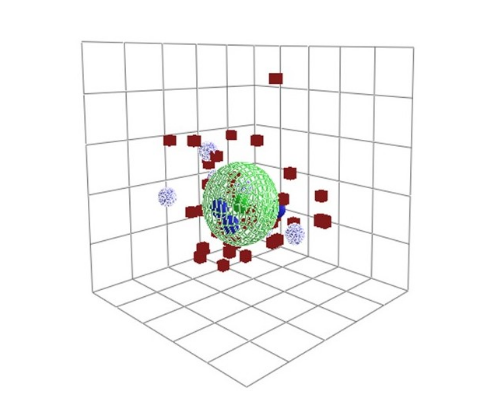
Figure 1. Schematic of the analysis using Hansen solubility parameters (HSP). Shorter distances between coordinates indicate greater affinity.
For me, hailing from Seto City in Aichi Prefecture—famous for Seto ware—ceramics were a familiar presence from an early age. While not solely for that reason, I specialized in piezoelectric ceramic materials during my graduate studies. Toyota Central R&D Labs has a long history of pressure sensor research (Related Page: Representative Awards – Piezo-Resistive Semiconductor Pressure Sensor]), and because they had published renowned papers on ceramic piezoelectric materials, I decided that joining them was the only way to truly master ceramic piezoelectrics.
However, the research theme assigned to me after joining was reaction simulation for power semiconductor crystal growth. Given my background in experimental studies, I was initially anxious, wondering, “Can I really do this?” With the help of colleagues, however, I gradually mastered the techniques step by step. Looking back, this experience proved to be an excellent opportunity for personal growth. Partly due to my inherent personality, I often tended to “just try the experiment first before thinking.” Simulation, however, can yield misleading or arbitrary results if performed carelessly, and blindly following such results would only hinder my own progress.
One major gain from this experience was developing the habit of carefully considering the meaning behind each parameter input into simulations and each step in experimental procedures as I advanced my research. While I still consider myself fundamentally an experimentalist, I have come to rely heavily on simulations.
Additionally, my professional experience working with power semiconductors at the module level has been extremely valuable for my current research on heat sinks (Figure 2). Understanding the application—where and how the material will be used—is essential for conducting truly useful research. If I had focused solely on the material itself, I might have concentrated only on properties such as thermal conductivity and insulation. However, my understanding of the module enabled me to design research that also considered mechanical characteristics during assembly. I believe this led to results that are more readily applicable to practical implementation. While creating materials with interesting properties may be sufficient in an academic setting, research in a corporate laboratory requires consideration of cost-effectiveness and mass-production feasibility. In that sense, gaining experience in a field slightly removed from one’s original specialty is extremely valuable for long-term career development.
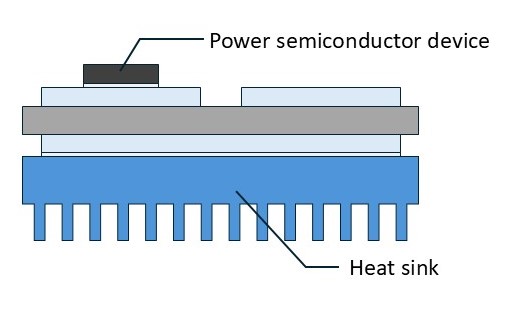
Figure 2. Schematic of a heat sink in a power semiconductor module. The heat sink material must possess high thermal conductivity as well as mechanical strength sufficient to withstand the assembly process.
For several years now, I have served as a team leader overseeing about ten members, primarily working on hybrid materials. Surprisingly, my childcare experience has been extremely useful in this management role.
Raising young children while working means that sudden calls from daycare due to fevers are routine occurrences. Such “uncontrollable events” are not unique to childcare; they happen frequently in any workplace. Learning how the team can support one another when these unforeseen events occur—and how to respond effectively—has been a significant growth experience for me.
There are likely many approaches, but what I value most is simply sharing information. For example, when a child is feeling unwell, we try to communicate as detailed as possible about our current situation within what we might say—things like, “It dropped to 37.5 degrees today, so I think tomorrow will be okay,” or “It looks like it will take another three days.” When everyone understands the situation, they can prepare accordingly and set up backup plans if needed. Prioritization is also crucial. If a task cannot move forward without my input or documents, I make it my top priority to ensure the team continues to function smoothly.
My hybrid materials team handles about five to six major research themes, and I am not an expert in all of them.
When I am unable to personally guarantee the quality of the research, I ask for help from someone with more experience. This is another lesson I learned from parenting: it is often more effective to clearly acknowledge what cannot be done and then move on to the next question— “So what should we do instead?” Even if it may feel like a burden at the time, I believe that successfully completing the work ultimately makes everyone happier.
Of course, when someone relies on me, I am committed to giving my full effort. At present, however, I feel that I am the one relying on my teammates the most. I have come to accept that this is not necessarily a bad thing, and I approach my daily work with a sense of openness and freedom. My hope is that people will think, “If even the leader relies on others, then it’s okay for me to ask for help when I’m stuck.” That said, I cannot rely on others indefinitely. Since becoming a leader, I have been striving to absorb new knowledge and skills in order to gain a broader perspective on the team as a whole. Ultimately, I aim to create a workplace where everyone—including myself—can grow through mutual reliance and support.