R&D Review


Smart Power Hub® can help to reduce energy cost for micro grids by making electricity conversion more efficient.
Although renewable energy use is advancing, the challenges of energy management, specifically how to generate, store, and use electricity, are becoming increasingly complex. Against this backdrop, microgrids, which enable autonomous energy management at the local level, are gaining attention as a key solution for countries with limited resources, such as Japan. Power conversion is a critical element in microgrids, alongside power generation facilities and storage batteries. This is because energy is lost exponentially with each additional conversion step.
How can we reduce this "hidden loss”?
The Smart Power Hub® (“SPH”) is one answer. With its three-port power converter structure that integrates power generation, storage, and consumption, SPH significantly reduces the number of conversion steps and cuts system-wide losses by approximately 45%. SPH did not emerge suddenly. According to researcher Goh Teck Chiang, it is a technology born from the accumulation of research that had previously "never seen the light of day," combined with the societal challenge of utilizing renewable energy.
Since coming to Japan from my home country of Malaysia to study, I have consistently been involved in power electronics research. As a student in a laboratory conducting power conversion research, I studied direct AC-AC conversion, which leading institutions had only just begun to pursue in earnest.
In retrospect, I consider myself very fortunate as a researcher to have conducted research during the period when direct AC-AC conversion research gained momentum. The central question I developed there—"How can we generate high-efficiency, high-quality waveforms?"—has remained a consistent guiding principle throughout my subsequent research career.
Since my student days, I have wanted to be involved in both basic and applied research that leads to real-world implementation. Having studied and grown as a researcher in Japan, I desire to contribute to Japan through technology. Toyota Central R&D Labs, Inc. seemed to me to be an attractive place to conduct research because I could contribute my research findings to Japan’s automotive industry, which continues to lead the world.
Since joining Toyota Central R&D Labs, I have continued my research on power conversion technology centered on direct AC-AC conversion. Even in fields that may appear distinct at first glance, such as DC-AC conversion or DC-DC conversion, insights from direct AC-AC conversion are indispensable for fundamental elements such as circuit configuration and control logic. The broad scope of direct AC-AC conversion technology leads to various applications, which is both the appeal and the challenge of this field.
At Toyota Central R&D Labs, the emphasis is placed not only on short-term technical research leading to commercialization, but also on long-term R&D and technical expertise accumulation. For instance, I have been engaged in power electronics research for electric vehicles since joining the institute, and this project has continued for over ten years. Among these projects, some themes were "shelved"—meaning research was temporarily halted— because they did not meet certain performance criteria or conditions. However, the valuable knowledge I steadily accumulated through these efforts has undoubtedly been stored within me. I know that the trial and error I experienced through those research projects helped me grow even further as a researcher.
Amid the societal trend of "the nation striving for carbon neutrality," interest in local energy production and consumption is growing. Microgrids are attracting attention as a solution to these challenges. To manage energy efficiently at small scales—such as in homes, stores, and factories, power conversion efficiency is paramount. Instead of straightforward subtraction, reducing the number of conversion steps yields exponential benefits. Once comprehending this concept, I recongized the potential value of the research I had conducted all along.
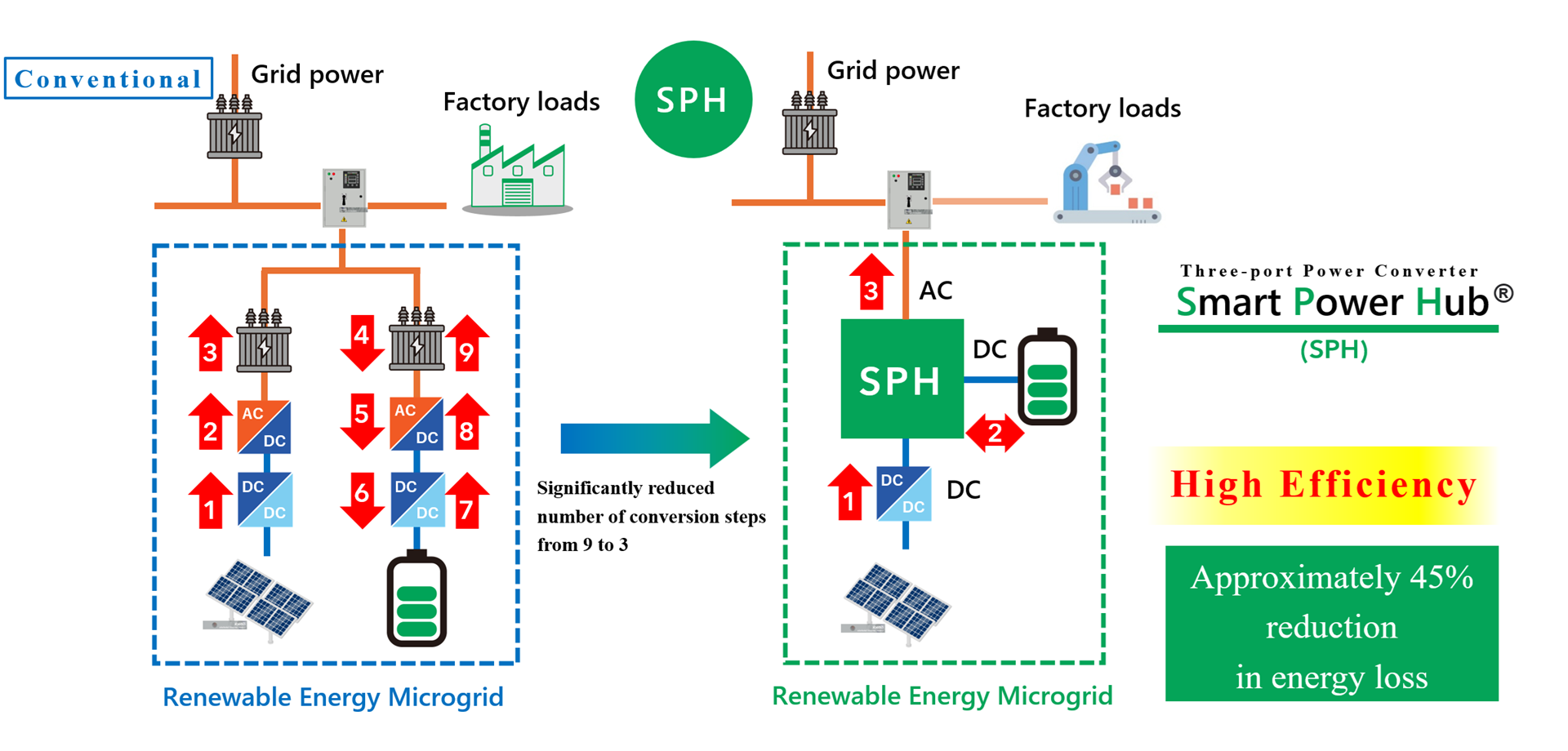
In conventional microgrids, multiple power converters are required between solar panels for power generation, batteries for energy storage, and AC loads. Due to the numerous processes involved in converting DC to AC and AC back to DC, the system's efficiency is compromised. To address this issue, we used the SPH technology, which has a three-port power conversion structure that combines power generation, storage, and consumption using circuit integration technology. This significantly reduces the number of power conversion steps. As a result, we achieved a reduction in system-wide losses of approximately 45%.
- 拡大
- Fig1. shows the power-conversion configuration of a conventional microgrid and the power conversion configuration using Smart Power Hub®.
The catalyst for creating SPH was an event where Toyota Central R&D Labs presented their research results to stockholders and technical collaboration contractor companies. Our independent research caught the attention of representatives from Daihatsu Motor Co., Ltd., and we began joint research after receiving a request. When conducting joint research with a business subsidiary, it is necessary to envision the final stage of technology commercialization and determine the research direction by working backward from that goal. The members of Daihatsu Motor were all highly passionate researchers and engineers. I believe a major factor in the success of the development was our ability to build a relationship based on deep mutual trust, while dividing responsibilities between the fundamental technologies handled by Toyota Central R&D Labs, and the demonstrations and implementations by the manufacturing companies.
On the other hand, I believe the significant efficiency improvements we achieved were made possible accumulating unnoticed research. Technologies that were "shelved" might not have been considered "successful" at the time, and might have been evaluated as "failures." However, I believe SPH would not have been born without that research. Through this research, I learned that accumulated failures can sometimes blossom in a completely different form in an entirely different field later on.
The pace of research and development is accelerating as the Internet expands information sharing and AI advances rapidly. It is precisely because we live in such an era that I believe that we should "steady our course by repeating small failures in short cycles." By conducting research without fear of failure, we can achieve future results in unexpected ways. SPH is a prime example of this. Research doesn't always lead to immediate results. The accumulated knowledge will inevitably prove meaningful somewhere down the line. If I have been able to convey even a little of this through my SPH research, I could not be happier as a researcher.
- 拡大
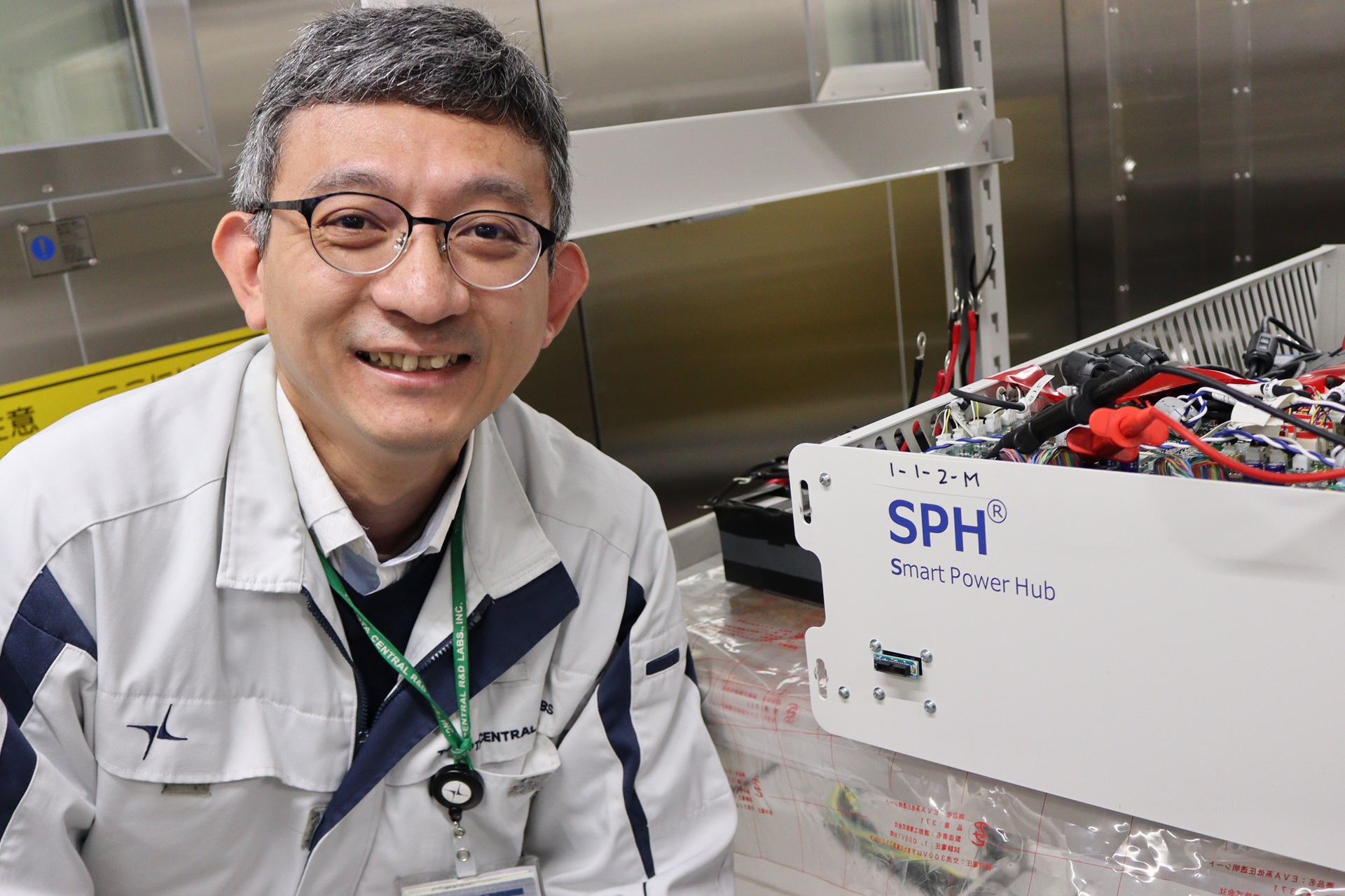
- The author alongside Smart Power Hub®.