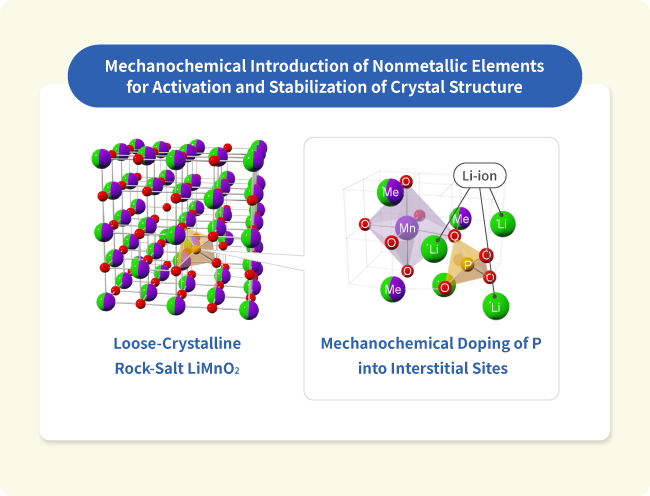
Controlling materials at the atomic level enables novel properties previously considered unattainable. As part of our research, we work on controlling the structure of abundant metals to impact functionalities comparable to those of precious metals.
For example, we have explored alternatives to cobalt and nickel species, both of which are commonly used as positive electrode materials in high-performance lithium-ion batteries. We focus on manganese species as sustainable alternatives and have demonstrated in small-sized batteries that lithium manganese oxides incorporating non-metallic elements such as boron or phosphorus into their crystal lattice can exhibit high capacity and extended cycling life.
This manganese-based approach is expected to enable high-performance batteries that are suitable for recycling.
This technology for controlling atomic-level structures holds promise for applications in a wide range of fields, from batteries to catalysts and energy generation.