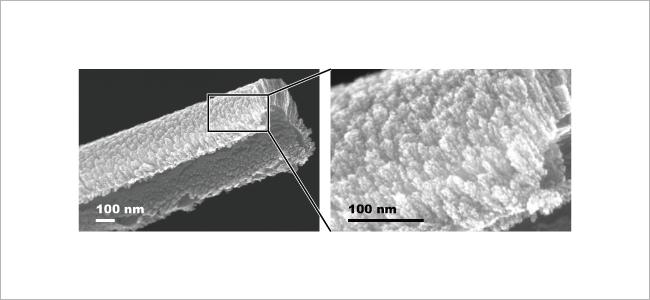
In aims of creating high-efficiency energy conversion materials and applying them to adhesive bonding of different materials and substances, we are working to develop various key technologies, such as controlling reactions occurring at material interfaces and surfaces, designing material structures, and analyzing reaction fields. As an example, we focused on the high activity of nanoparticles and established a method that forms rutile IrO_{2} crystal clusters with a diameter of 1 - 3 nm into free-standing, substrate-less fiber catalysts connected at the crystal domain boundaries by sputtering nanoparticles onto non-woven fabric’s surfaces made using electrospinning (NUNO: Nano particles United Non-woven-Object). Since the results have a large catalytic reaction surface due to the formation of gaps between the particles, these materials hold the potential for application to water-splitting catalysts with high activity, all while reducing the amount of material used.
Reproduced from J. Mater. Chem. A, 2020, 8, 25061(DOI: 10.1039/d0ta07707k) with permission from the Royal Society of Chemistry.
SEM images of a prototype nanostructure catalyst material
(The gaps formed between the particles achieve a larger surface area)