Our research focuses on the mathematical modeling of complex natural phenomena using machine learning models that incorporate physical laws and constraints as prior knowledge. One application of this work is providing more detailed climate projections.
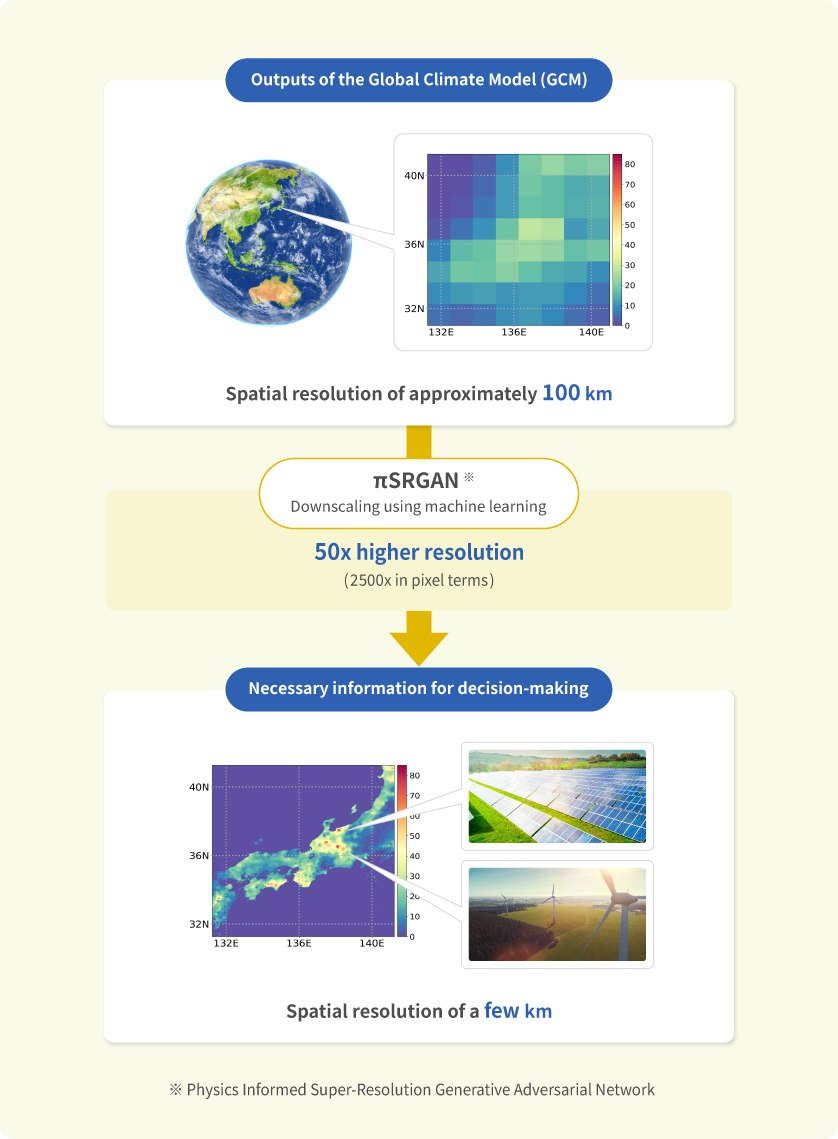
Accurate, long-term climate projections are necessary to address climate change issues. The spatial resolution of climate information must be at least a few square kilometers. However, most current global climate simulations use grid spacings with a resolution of approximately 100 kilometers.
To fill this resolution gap, a research team from the National Institute for Environmental Studies (NIES) and our company developed a downscaling method for temperature and precipitation, called “πSRGAN”. This method improves accuracy by incorporating auxiliary information, such as sea level pressure and topography, into machine learning. These factors are considered to be highly climatologically correlated with the targeted variables.
Therefore, detailed information on several square kilometers can be obtained from predicted information on the order of 100 km. Further verification using real data shows that, in addition to local temperature and precipitation statistics, the relationship between distant climatic phenomena can be rapidly projected in detail.
This technology is expected to be applied not only to downscale climate information, but also to understand and control difficult-to-elucidate phenomena, such as the behavior of powders and complex fluids.