





























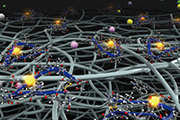
How Does Pore Size Control Fuel Cell Performance? Insights from Mesoporous Carbon
A study conducted by Tomohiro Takeshita et al. was published in the ACS Catalysis.
Polymer electrolyte fuel cells are attracting attention as clean energy devices because they generate electricity without emitting CO₂. Improving their performance requires efficient electrochemical reactions at the electrodes, where platinum catalysts supported on carbon materials play a crucial role. One long-standing challenge is that ionomers—polymers added to conduct protons—can cover the platinum surface and suppress catalytic activity. Although mesoporous carbon supports have been proposed as a solution, the effect of pore size has not been fully clarified experimentally.
In this study, we systematically investigated carbon supports with precisely controlled mesopore sizes while keeping particle size constant. By combining electrochemical measurements and structural analyses, we found that excessively large pores allow ionomers to penetrate deeply, causing catalyst poisoning and higher proton transport resistance. Conversely, very small pores also reduce performance due to unfavorable catalyst distribution. These results demonstrate that intermediate pore sizes provide the best balance, offering clear design guidelines for high-performance fuel cell cathodes and contributing to the development of more efficient and sustainable energy technologies.
Title: Effect of the Pore Size of Mesoporous Carbon Supports for Cathode Catalysts on the Cell Performance of Polymer Electrolyte Fuel Cells
Authors: Takeshita, T., Yano, K., Kodama, K.
Journal Name: ACS Catalysis
Published: August 1, 2025
https://doi.org/10.1021/acscatal.5c04074